
James Carville's 1992 campaign note read "It's the economy, stupid." The workplace-AI version is shorter on charm and longer on consequence: it's the ecosystem. The company that wins the AI sitting on your desk will not be the one with the highest score. It will be the one that already owns your inbox, your files, your calendar, and the permission model wrapped around all three.
Microsoft and Google will dominate workplace AI through and Gemini. Not because those products are the best available models, which they often are not, but because they live inside the business context, inherit the governance enterprises already trust, and connect to everything else by default. They are good enough, and good enough plus already-here beats excellent-but-elsewhere almost every time.
The large platforms will not lose. , , and will ship capable . But each is bounded by its own playground. Salesforce agents will be brilliant inside the and largely invisible outside it. The smart move for those vendors, which some are already making, is to stop fighting to be the screen you look at and become the validated data model and business logic that someone else's agent calls into, through , MCP, and A2A.
And as the interface becomes something an agent generates on demand, the graphical stops being the product. When the screen can be assembled per task (a form here, a voice conversation there, a table of numbers when you need to analyse something), enterprises stop paying to customise Salesforce inside Salesforce. They start shopping for the parts: trusted data models, services, and APIs they can assemble themselves.
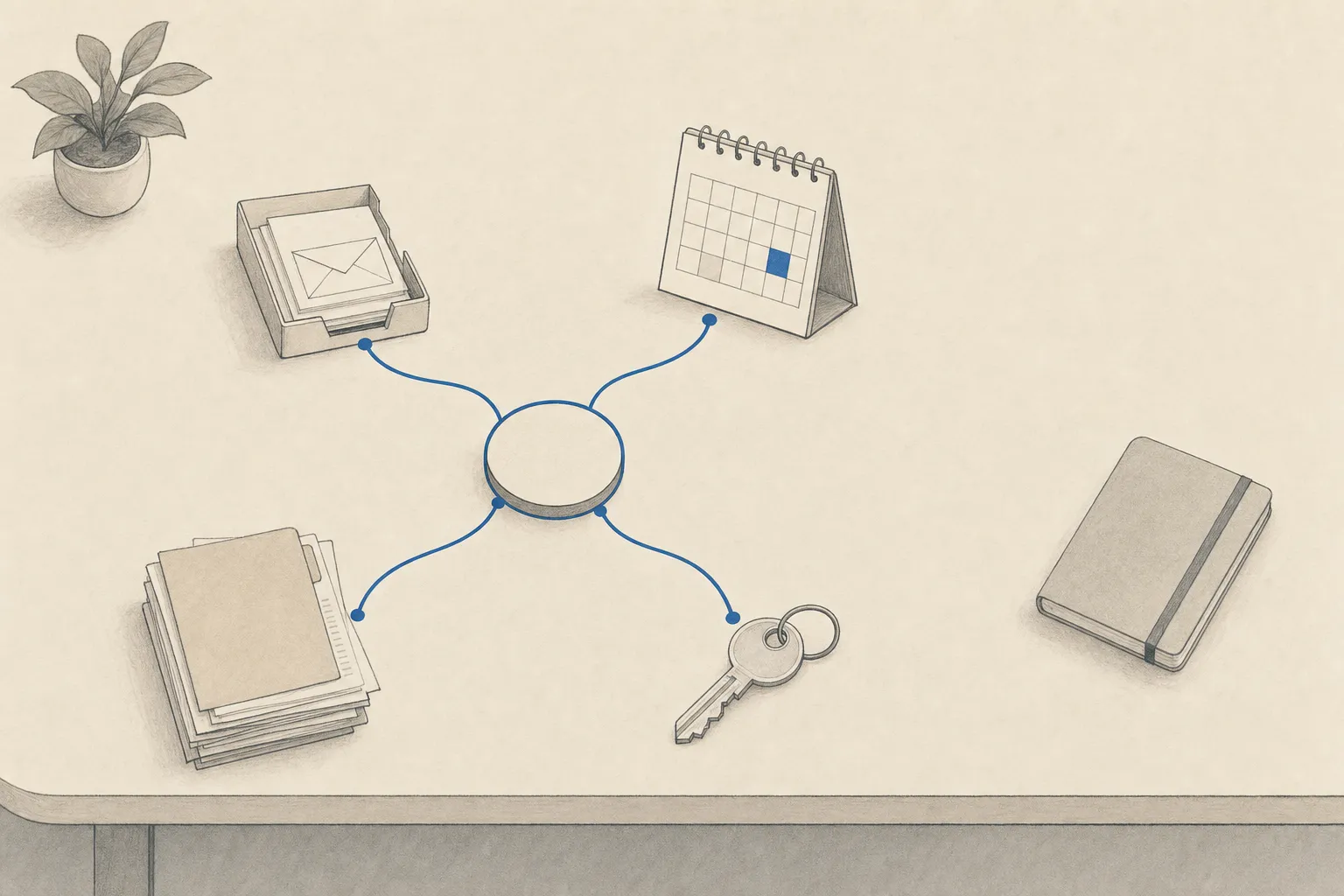
In this article. The case that workplace AI will be decided by who owns the desk, the data, and the governance, not by who ships the best model, and what that does to platform competition, vendor selection, and the build-or-buy call.
- The distribution already exists: Copilot and Gemini seat counts, and why distribution has come apart from model preference.
- The moat nobody demos: identity, permissions, and governance as the factor that decides procurement.
- The SaaS platforms get a smaller board: 's growth, its confinement to the CRM, and Salesforce going headless.
- The stops being the product: and the disposable interface.
- The buy decision changes shape: Salesforce versus Dynamics once customisation stops counting, and when a smaller firm should build rather than buy.
- What makes the assembly possible: MCP, A2A, and the standards that let you shop for parts.
- The strongest objections: where the argument is weakest.
- What to do about it: the practical takeaways.
The distribution already exists
Microsoft 365 Copilot crossed 20 million paid enterprise seats, reported on its fiscal Q3 2026 earnings call (April 29, 2026), up from 15 million at Q2 (January 2026), a 33% quarter-on-quarter jump. More than 60% of the Fortune 500 now run at least 10,000 seats, and individual deals run large: Accenture alone took 740,000, Microsoft's largest Copilot win to date .
| Copilot paid seats | Gemini Enterprise seats | Workspace paying orgs |
|---|---|---|
| 20M | 8M+ | 10M+ |
| Microsoft, Apr 2026 | across 2,800+ firms | Google Workspace |
Google's path is the same shape from the other end. Gemini is built into Workspace, which serves more than three billion users and over ten million paying organisations. At Next '26 (April 2026) Google reported more than eight million paid seats across 2,800-plus companies , and in January 2025 it folded the AI into Workspace pricing rather than charging a separate add-on, dropping the standalone $20-to-$30/user/month Gemini add-on while raising base plan prices about 17% . KPMG reported around 90% internal adoption of Gemini Enterprise ; Mars designated it the primary AI operating system for its global workforce .
The seat trajectory tells the real story: momentum, not merit.
| Period | Copilot paid seats |
|---|---|
| Mid 2024 | ~10M |
| Late 2025 (Q2 FY26) | ~15M |
| April 2026 | 20M |
Sources: Microsoft financial disclosures; NoJitter; Recon Analytics via Stackmatix (2026). Pricing: $30 per user per month on top of M365.
Now the part that should give the model-first crowd pause. In Recon Analytics' survey of more than 150,000 US paid AI subscribers, Copilot's share fell from 18.8% in July 2025 to 11.5% in January 2026, ceding the number-two spot to Gemini (which climbed from 12.8% to 15.7%) . Copilot is, by that measure, becoming a less-preferred consumer product even as its enterprise seat count climbs toward the ceiling. Preference and distribution have come apart.
Distribution outruns preference
Copilot's surveyed share of paid AI users slipped by nearly 40% in six months, yet its enterprise seat count kept climbing. The default that sits inside Outlook and Teams wins the work even when it is no longer the model people would choose on a blank page.
A counter is that 20 million seats is still under 5% of Microsoft's roughly 450 million commercial Microsoft 365 base, and that license-to-active-use conversion sits around a third. True. Ownership of a category does not require universal adoption. It requires being the option that wins by default whenever an organisation does decide to buy. That default position is what Microsoft and Google already hold, and neither earned it with a model.
The moat nobody demos
Ask why a regulated enterprise picks Copilot or Gemini over a better standalone assistant and the answer is rarely about output quality. It is about whether the assistant can see the right documents for the right person, respect the sharing rules built up over a decade, leave an audit trail, keep data in the right region, and survive a security review. Copilot inherits the Microsoft 365 identity and permission model and the Purview compliance stack. Gemini in Workspace carries Google's enterprise data protections, with prompts and generated content staying inside the tenant and out of training.
Bolting those on is a project. Having them by default is a product.
A standalone , however good, starts that work from zero. It has no native view of your permission graph, no inherited audit trail, no place in your identity provider.
The governance moat
Identity, permission inheritance, audit, and data residency decide enterprise AI procurement, and none of them appear in the keynote demo. The boring layer is the moat.
This is why "good enough" is not a concession in this argument. For the large majority of workplace tasks (summarise this thread, draft that reply, find the deck, pull the numbers), model quality passed the bar a while ago. The differentiator moved to context and control, which the incumbents already own. They can also swap the model underneath when it matters: Copilot runs multiple models, and Google's enterprise platform now offers more than 200, including 's . The model has become an input you can change; the ecosystem is the thing you cannot.
The SaaS platforms get a smaller board
None of this means Salesforce, SAP, or ServiceNow are in trouble. Agentforce and Data 360 are the fastest-growing product category in Salesforce's history. They reached roughly $1.4 billion in combined by the third quarter of fiscal 2026, up 114% year over year, with more than 18,500 Agentforce deals (over 9,500 of them paid) by Q3 and the deal count climbing further by year-end . These are real outcomes, not slideware.
But look at where the growth comes from. More than half of Agentforce and Data 360 bookings came from existing customers expanding their spend . That is the signature of a product going deeper into its own territory, not breaking out of it. Agentforce makes the CRM more valuable to people already in the CRM. It does not become the place a marketer goes to prep for a meeting, the surface a finance analyst opens to close the books, or the assistant that drafts the all-hands email. Those live where the work and the documents already are: in Microsoft's and Google's houses.
The strategically interesting response is that Salesforce appears to have read this clearly. At TDX on April 15, 2026 it announced Headless 360, which exposes the entire platform (data, workflows, business logic, even Slack) as APIs, MCP tools, and commands. Day one shipped 100+ tools and skills, including 60+ MCP servers, 30+ preconfigured coding skills, and an open-sourced Agent Script DSL . The browser stops being the required way in. Marc Benioff summed it up: "No browser required. Our API is the UI." A separate experience layer renders interactions across surfaces from Slack to voice.
Salesforce reads the room
Headless 360 turns the CRM into something other agents call rather than a destination you log into. Instead of defending the point-and-click UI as the product, Salesforce is repositioning as validated infrastructure (the data model and the governance around it) that the workplace AI consumes.
That is the right move under the constraint. If you cannot own the daily work surface, become the trusted system the surface reaches into. The topology that results looks like this:
The workplace AI sits at the centre because it owns the identity and the document graph. The domain platforms become specialised back ends, accessed through standard protocols. They keep their data models and the business rules baked into them, which is a durable position. It is a smaller board than the one they used to play on, and they no longer control where the player sits.
If you plot the field on two axes (how much of the daily work surface a vendor owns, and how strong its model or agent is), the workplace winners cluster in a corner that has nothing to do with frontier model leadership.
The frontier labs sit top-left: strongest models, weakest hold on the work surface. The domain platforms sit bottom-left: capable agents confined to their patch. Microsoft and Google occupy the right edge, which is the side that ships to 450 million desks.
The GUI stops being the product
The last pillar is the one that reorganises everything underneath it. As agents get better at assembling interfaces on demand, the graphical UI stops being a thing you buy and becomes a thing that is generated for the moment.
SAP has been unusually direct about this. In a March 2026 SAP News Center piece it describes generative UI as a move from static software suites to "batch size 1" applications, ephemeral control centres that materialise around a user's intent and dissolve afterward . The same underlying services drive a plain input form when someone is entering data, a chart-and-table view when someone is analysing, and a voice conversation when someone is prepping for a client meeting on the drive there. A growing stack of standards (AG-UI, A2UI, MCP Apps) exists precisely to let agents describe and these interfaces at runtime rather than have engineers hand-build them in advance.
The data-platform equivalent, when the itself is the disposable artefact, is treated separately in:
Once the interface is disposable, the question of what you own changes shape. You are no longer paying for screens and configuration pages. You are paying for the data model that is correct, the services that enforce the business rules, and the APIs that carry governance with them. The screen is rendered fresh each time; the validated model behind it is the asset.
The procurement question changes
It stops being "which suite has the best UI and how much do we customise it?" and becomes "whose data model and API will we let our agents call, and does the governance travel with the call?"
This is why the long, expensive practice of customising Salesforce inside Salesforce (building screens and page layouts that only live in that vendor's UI) starts to look like a poor investment. The UI work has the shortest shelf life of anything you can buy. The data model and the governed API have the longest. Enterprises will increasingly pick and choose: this vendor's customer model, that vendor's billing logic, an internal service for the part nobody sells well, all assembled behind agent-generated surfaces tailored to each role and task.
The buy decision changes shape
If the interface is no longer the product, then two procurement habits that have held for two decades start to wobble: which vendor you pick when several can do the job, and whether you buy at all.
Picking between incumbents: Salesforce versus Dynamics
For years the CRM bake-off turned heavily on customisation and interface extensibility. Salesforce won a lot of those evaluations on exactly that ground: a build-anything architecture, the deepest configuration in the market, and the widest partner network. It still leads the category, holding roughly a quarter of the global CRM market and a presence in more than 80% of the Fortune 500.
But the thesis above removes the thing Salesforce was winning on. If screens are generated per task by an agent, and the platform is consumed headless through APIs and MCP, then "how configurable is the vendor's UI" stops being a tiebreaker. The question collapses back onto the factors this whole piece is about: which ecosystem does the system already live inside, does it inherit governance you trust, what does it cost, and how much of your data model does it cover.
On those factors, for an organisation already standardised on Microsoft 365, has structural advantages that have nothing to do with being a better CRM.
| Decision factor | Salesforce | Dynamics 365 |
|---|---|---|
| Sales Enterprise list price | $175 / user / mo | $105 / user / mo |
| Bundled AI | Agentforce, usage-based Copilot Credits | Copilot included at no extra cost since Oct 2025 |
| Data-model breadth | CRM-centric; ERP via partners | Unified CRM + ERP via Business Central |
| Natural fit | Existing Salesforce / Slack estate | Existing Microsoft 365 / Teams / Azure estate |
| Customisation depth | Deepest in the market | Strong, less deep |
Salesforce Sales Cloud Enterprise listed at ~$175 after the August 1, 2025 ~6% list-price increase [R14]; Dynamics 365 Sales Enterprise listed at $105 with Copilot for Sales included at no extra cost from mid-October 2025 [R13].
Read the last row as the one losing its weight. Salesforce's customisation depth was the premium an organisation paid for. When the UI is generated and the platform is consumed headless, that premium buys less, and the rows above it (price, bundled AI, ecosystem fit, CRM-plus- breadth) decide more. For a Microsoft shop, the sums quietly tilt toward Dynamics, and the AI layer arriving at no extra cost while Salesforce meters Agentforce by usage sharpens the tilt.
The bake-off changes ground
Once interfaces are generated, the CRM choice stops being about customisation depth and becomes about ecosystem fit and price. For an organisation already inside Microsoft 365, that favours Dynamics without Dynamics being the better CRM.
The qualifier: Salesforce still wins on out-of-the-box depth and ecosystem breadth, and a firm already deep in the Salesforce and Slack estate has every reason to stay. Headless 360 is partly Salesforce's answer to this exact pressure. By turning itself into infrastructure any agent can call, it makes the "which estate are you in" question matter less, because it can be the governed data model behind a Microsoft or Google surface just as easily as behind its own.
Build versus buy, now that building is possible
The same shift reaches further down the market, and changes a decision smaller firms never got to make.
Building a CRM, an inventory tracker, a ticketing system, or an onboarding tool used to be effectively out of reach for a small or mid-sized company without developers on staff. So the choice was never build versus buy. It came down to buying a SaaS seat or torturing a do-everything spreadsheet into a half-working application and living with it. Buy won by default because build was not on the menu.
It is now. A technically minded person who is not a software engineer can direct coding agents to stand up a tailored , and the models are strongest at precisely the surfaces this argument privileges: command-line tools, MCP servers, APIs, and competent web front-ends. The scaffolding that used to be a multi-month project (a sensible data model, the around it, a usable screen) is now closer to a weekend. Eno Reyes, co-founder of Factory, has described the enterprise version of this shift in agent-native development, where the software most exposed to in-house assembly is the connectors and small internal-data utilities that ring the big systems .
The catch is that what you were buying with SaaS was never the CRUD screens. It was the maintenance, the security, the compliance, the validated data model, the integrations, and the fact that someone else owns the thing forever. Those do not come out of a coding agent for free. Recent measurements put AI-generated code at noticeably higher vulnerability density than human-written code. Veracode found GenAI models chose an insecure implementation in 45% of tasks, 2.74x the human baseline , and Apiiro reported AI coding assistants delivering roughly 4x the velocity but 10x the security findings inside Fortune 50 codebases . Anything touching regulated data also drags in and obligations that agents do not produce on their own.
The same "pay for the backend, not the buttons" prediction, seen from the engineer's side:
The floor moved, not the ceiling
AI scaffolds the data model and the CRUD; it does not hand you maintenance, security, or compliance. The range of what a small team can responsibly build expanded. The range of what it can responsibly self-build for a regulated, mission-critical workload barely did.
So the line moves; it does not vanish. Simple, internal, low-stakes, standard-shaped applications tip toward build. Regulated, mission-critical, , or liability-bearing systems stay buy, because the vendor's real product is the maintenance and the governance, not the form fields. And even on the build side, the sensible pattern avoids writing everything from scratch. It assembles validated data models and governed APIs and lets the agent wire them together behind a generated interface, which is the main thesis again, seen from the small firm's side. Whether a mid-market company picks Dynamics over Salesforce or a ten-person shop builds its own tracker instead of buying a seat, the deciding factor stopped being the interface and became the data model and the ecosystem the thing already lives in.
What makes the assembly possible
A thesis about picking and choosing parts only holds if the parts plug together. In 2024 they mostly did not. By 2026 the connective tissue is real.
| MCP SDK downloads | A2A organisations | AAIF backers |
|---|---|---|
| tens of M/mo | 150+ | 8 |
| Python + TS, early 2026 | one year after launch | Anthropic, Block, OpenAI + Google, Microsoft, AWS, Cloudflare, Bloomberg |
The , created by Anthropic and donated to the 's newly formed Agentic AI Foundation (AAIF) in December 2025, standardises how an agent connects to tools and data. The AAIF was co-founded by Anthropic, Block, and , with Google, Microsoft, , , and Bloomberg among its platinum backers . By early 2026 its were seeing tens of millions of downloads a month, with adoption across Anthropic, OpenAI, Google, Microsoft, and Amazon. The protocol, started by Google in April 2025 and handed to the Linux Foundation that June, passed 150 supporting organisations at its one-year mark, with Google, Microsoft, AWS, Salesforce, SAP, IBM, Cisco, and ServiceNow among supporters . MCP handles agent-to-tool; A2A handles agent-to-agent; both now sit under neutral governance whose backers include every major player at once.
When the major vendors agree to a shared interconnect, the cost of assembling best-of-breed parts collapses, and the value of any one vendor's proprietary UI collapses with it. Gartner's estimate that a third of enterprise software applications will embed agentic AI by 2028, up from under 1% in 2024, is less a forecast about features than about this plumbing becoming standard .
The strongest objections
The argument has real weak points. Here they are.
The frontier still matters. For the hardest reasoning, the best model is not interchangeable, and the labs that build it (OpenAI, Anthropic) hold mindshare the incumbents would love. The response is twofold: most workplace tasks do not need the frontier, and the incumbents can rent the frontier when they do, swapping models behind a surface they own. Mindshare is not the same as owning a company's identity provider and document store. The labs are competing to be the model layer and the standards body, which they co-founded, rather than the default workplace surface, a powerful position but a component's position.
Switching costs could keep users locked in vendor UIs. They might, for a while. But Headless 360 is Salesforce itself dissolving its UI lock-in into API and governance lock-in. The latter is more durable for the vendor and, awkwardly for the lock-in argument, more interoperable for the customer. The data-model dependency persists; the screen dependency does not.
And it could all be slower and smaller than the headlines suggest. Adoption is real but uneven: Copilot at under 5% of its addressable base, roughly 6% of Salesforce customers paying for Agentforce. This piece is not a claim that the shift has happened. It is a claim about where the value lands as it happens, and the direction of that landing is already visible in the seat counts and Salesforce's own architecture.
These are early innings. The thesis is about the slope, not the score. If adoption stalls, the question of who owns workplace AI stays open longer, but the factors that will decide it do not change.
What to do about it
Workplace AI will not be won on a leaderboard. It will be won by whoever already sits between the worker and the work: the identity, the inbox, the files, the calendar, and the governance that makes all of it auditable. That description fits Microsoft and Google today, and "good enough" models in that position beat better models without it.
The large SaaS platforms keep their domains and, if they are sensible, lean into being headless: validated data models and governed APIs that the workplace AI calls through MCP and A2A. Salesforce has already chosen this path. The graphical interface, meanwhile, decays from product to disposable output (generated per task, per role, per moment), which moves the buyer's attention to the model and the API underneath.
For anyone architecting this, the practical reading is short. Invest in your data model and your governance, because they outlive everything above them. Treat user interfaces as disposable and resist deep customisation inside any single vendor's screens. Evaluate vendors on the quality and governance of their API and MCP surface, not the polish of their UI. When you compare two suites that can both do the job, let ecosystem fit and price break the tie, because the customisation depth that used to break it now buys less. And revisit the build-versus-buy line for your simpler internal systems: some of what you pay a vendor to host is now cheaper to assemble, as long as you are honest about which workloads still need someone else to own the maintenance and the compliance. Above all, assume the agent on the desk will belong to whoever already owns the desk.
What it actually takes to make a data model an agent can use:
Final thought
It's the ecosystem.
It's the Ecosystem, Stupid! · June 2026 · A strategy piece. Sources: Microsoft FY2026 earnings (April 2026); Google early-2026 disclosures and Google Cloud Next '26; Salesforce FY2026 Q3/Q4 earnings and TDX 2026 (Headless 360); SAP News Center on generative UI (March 2026); Recon Analytics via Stackmatix; Linux Foundation A2A milestone (April 2026); Agentic AI Foundation / MCP figures (Dec 2025–Feb 2026); Gartner; vendor pricing pages for Salesforce Sales Cloud and Dynamics 365 (2026); AppDirect and CIO reporting on build-versus-buy and AI-assisted development (2026). Vendor seat and ARR figures are company disclosures; survey-based market-share and code-quality figures are third-party estimates. Some figures combine related product lines as the vendors report them.
References20
- 1NoJitter, "Microsoft 365 Copilot hits 20 million paid seats" (20M at Q3 FY2026, up from 15M at Q2; Accenture 740,000; 60% of Fortune 500 with 10,000+ seats), April 2026. nojitter.com ↗
- 2Microsoft, "Microsoft Fiscal Year 2026 Third Quarter Earnings" (April 29, 2026). microsoft.com ↗
- 3The Next Web, "Pichai opens Cloud Next 2026… 750M Gemini users" (Gemini Enterprise 8M+ paid seats across 2,800+ companies), April 2026. thenextweb.com ↗
- 4KPMG, "KPMG named 2026 Google Cloud Partner of the Year for Global Industry Solutions: Breakthrough" (~90% internal Gemini Enterprise adoption), April 2026. kpmg.com ↗
- 5Mars, "Mars partners with Google Cloud to empower global Associates with Gemini Enterprise" (Gemini Enterprise as primary AI operating system). mars.com ↗
- 6Google Workspace, "Empowering businesses with AI" (Gemini bundled into Workspace plans; standalone add-on dropped; base prices rose ~17%), January 2025. workspace.google.com ↗
- 7Recon Analytics, "AI Choice 2026: Why Licenses Don't Equal Adoption" (Copilot share 18.8%→11.5%; Gemini 12.8%→15.7%; survey of 150,000+ US paid AI subscribers). reconanalytics.com ↗
- 8Salesforce, "Salesforce Delivers Record Third Quarter Fiscal 2026 Results Driven by Agentforce & Data 360" (≈$1.4B combined ARR, +114% YoY; 18,500 deals, 9,500+ paid; >50% bookings from existing customers), December 3, 2025. salesforce.com ↗
- 9Salesforce, "Salesforce Delivers Record Fourth Quarter Fiscal 2026 Results". investor.salesforce.com ↗
- 10Salesforce, "Introducing Salesforce Headless 360. No Browser Required." (entire platform as APIs/MCP/CLI; 100+ tools, 60+ MCP servers, Agent Script), TDX, April 15, 2026. salesforce.com ↗
- 11Marc Benioff (@Benioff), "Welcome Salesforce Headless 360: No Browser Required! Our API is the UI.". x.com ↗
- 12SAP News Center, "Why Is Generative UI the New Frontier for Business Software?" (generative UI as "batch size 1" applications; A2UI), March 2026. news.sap.com ↗
- 13Rand Group, "Complete guide to Dynamics 365 Sales pricing" (Sales Enterprise $105; Copilot for Sales included from mid-October 2025). randgroup.com ↗
- 14Salesforce, "Salesforce Announces Pricing Update" (~6% list-price increase effective August 1, 2025; Sales Cloud Enterprise to ~$175). salesforce.com ↗
- 15Stack Overflow Blog, "Code smells for AI agents: Q&A with Eno Reyes of Factory", February 4, 2026. stackoverflow.blog ↗
- 16Veracode, "2025 GenAI Code Security Report" (insecure implementation chosen in 45% of tasks; 2.74x more vulnerabilities than human-written code). veracode.com ↗
- 17Apiiro, "4x Velocity, 10x Vulnerabilities: AI Coding Assistants Are Shipping More Risks", 2025. apiiro.com ↗
- 18Linux Foundation, "Linux Foundation Announces the Formation of the Agentic AI Foundation (AAIF)… including Model Context Protocol" (co-founders Anthropic, Block, OpenAI; platinum backers AWS, Bloomberg, Cloudflare, Google, Microsoft), December 9, 2025. linuxfoundation.org ↗
- 19Linux Foundation, "A2A Protocol Surpasses 150 Organizations, Lands in Major Cloud Platforms, and Sees Enterprise Production Use in First Year", April 2026. linuxfoundation.org ↗
- 20Gartner, "Agentic AI: Autonomy Is Coming" (33% of enterprise software applications to include agentic AI by 2028, up from less than 1% in 2024). gartner.com ↗