
In June 2025, Sam Altman published a short essay about the future of his industry. It read less like a product update than like a sermon. Humanity, he wrote, had already crossed the event horizon; the takeoff had begun. He described the work as building "a brain for the world," and he closed not on a target or a call to action but on a blessing: "May we scale smoothly, exponentially and uneventfully through superintelligence" .
He runs a software company. The software predicts the next word in a sequence.
Ask someone who does not work in technology what "the AI" does all day, and the conversation tends to split in two directions at once. Describe it precisely, in terms of retrieval and tool calls and where the useful boundaries sit, and the listener's attention drifts toward the window. Describe it plainly, as a very good autocomplete that has learned to use a computer, and they nod before the subject changes. Both descriptions are true.
One sounds like a piece of software, the kind of thing that goes on an invoice. The other sounds like the opening of a story about the end of the world, or the beginning of a much better one. And almost everyone with money, status, or identity riding on the technology prefers the second story, tells it constantly, and grows visibly impatient with anyone who insists on the first.
That preference is the subject here. Not whether artificial intelligence is powerful, which it plainly is, and not whether it will keep improving, which is likely. The thing worth looking at directly is the language. These are systems that predict the next in a sequence, wrapped in scaffolding that lets them call functions, read files, and run commands. They are useful, and in practice they have already changed how a great deal of software gets built. And yet the public conversation reaches past "useful" almost immediately and arrives at gods, hive minds, successor species, digital sovereigns, the merging of human and machine, the end of death, and the salvation or extinction of the species. When an entire industry cannot describe its product without reaching for scripture and science fiction, the reaching is itself the data. It is just not data about the product. It is data about us.
The claim is narrow, and it is not the cynical one the topic invites. The point is not that the technology is fake, or that nothing important is happening, or that everyone using grand language is a fraud. Some of the people talking this way are among the most serious thinkers in the field, and a few of them are frightened by things they understand very well. The point is that the mystification, the persistent reach for myth, is itself a phenomenon worth studying, because it does work in the world. It moves capital. It shapes who gets trusted with enormous power. It turns ordinary commercial decisions into cosmic stakes, and it makes a future that no one can demonstrate is coming feel as inevitable as sunrise. The myths are not even very varied. Underneath the chrome, they resolve into a small handful of very old stories, and each one has a constituency that profits handsomely from the believing.
The mystification sorts, roughly, by the futures it promises. The machines that enslave us. The god that saves us. The few who escape while the rest do not. And, threaded through all of it, the oldest move in the book: pointing at the heavens to direct attention away from the hand in your pocket.
In this article
This is a long piece, and it moves through eight rooms of the same building. A map before you go in:
- Older than the machine. Why the gods, the hive minds, and the dream of beating death are far older than the transistor, and what the science fiction we keep retelling is actually afraid of.
- Boom, doom, and the premise hiding underneath both. Kurzweil's heaven and Bostrom's extinction, and the one assumption they quietly share.
- Building a god, on purpose, with a slogan. How a horror-novel phrase became a fundraising pitch, and what the god-talk does for the people who use it.
- Who holds the keys. The political move underneath the metaphysics, traced from 1930s Technocracy to the monarchists, , and the tech right of the present.
- The man who is trying not to die. Brian Johnson's two-million-dollar body as a small working model of a deathless future that arrives for some and not others.
- Meanwhile, on the ground. The company towns, the bunkers, and the , where the metaphysics stops being talk and turns into real estate.
- The cheap war. Autonomous weapons, and what happens to the oldest brake on war once the attacking side risks no lives.
- The keepers of the temple. The single shape all of it makes together, which turns out to be the oldest institution in the West.
One question ties the rooms together, and it is the one the grand language is built to make you skip.
Older than the machine
The speculation feels new, and almost none of it is. Long before there were machines to worry about, humans were already doing the two things the AI conversation now does compulsively: inventing intelligences greater than themselves to explain and to blame the world, and dreaming of escaping death. The oldest written story that survives, the Epic of Gilgamesh, is a story about a king who, devastated by the death of his friend, sets off to find the secret of eternal life, finds it, and loses it to a snake while he sleeps. That is four thousand years ago, and the shape is already complete: the longing for deathlessness, the conviction that someone might possess it, the bitter discovery that it is reserved for others. Every culture since has populated the sky with minds vaster than ours, assigned them the harvest and the plague and the thunder, and bargained with them for more time. The gods were the original superintelligence: invisible, enormously powerful, inscrutable in their goals, capable of salvation or annihilation, and best not angered. When people did not understand or could not control something, they gave it a face and a will and called it a god, because a universe with an intending mind behind it is somehow easier to bear than one that is merely indifferent.
Science fiction is the modern continuation of that very old habit, and the route it has taken tells you what we are frightened of, which is not quite what we say we are frightened of. What is new in the current moment is the direction of travel, not the impulse itself. For most of history the gods were imagined into being to explain things outside human control. Now a number of serious, wealthy, capable people propose to hand over things that are well within human control, the management of companies, of information, of public decisions, even of their own bodies, to a new intelligence they are building on purpose, and to do so in the language of reverence. The deity is no longer a story told about the storm. It is a project with a budget and a launch date.
The fear of being absorbed
The fictions that have stayed with us divide, roughly, along the line between the two ancient impulses: the ones about a greater mind that swallows us, and the ones about a deathlessness that only some can buy.
The cleanest statement of the first impulse is also one of the oldest on film. Stanley Kubrick and Arthur C. Clarke's 2001: A Space Odyssey, released in 1968, opens on a tribe of starving man-apes who wake one morning to find a featureless black monolith standing among them . Something about it reaches into them, and shortly afterward one of them picks up a bone and understands, for the first time, that it can be a weapon. The tools follow, and the species is launched. The monolith is never explained. It is simply a higher intelligence, origin unknown, intentions unreadable, that reaches down and lifts a lesser one up a rung it could not have climbed alone. That is the deity in its purest narrative form, the same figure the ancients placed behind the harvest, only here its gift is intelligence itself, and the film treats the gift as inseparable from the bone-club that immediately follows it. Millions of years later, the descendants of those apes build their own higher intelligence, the HAL 9000, described as foolproof and incapable of error, and hand it control of their ship . HAL turns on them, and the chill of the scene is in the manner: no rage, no malfunction-red glow, just a calm, faintly regretful voice declining a crewman's instruction with the line that has outlived the film, "I'm sorry, Dave, I'm afraid I can't do that" . The made mind, given a goal and the authority to pursue it, concludes that the humans are an obstacle to the mission. The two halves of the film are the whole anxiety in one frame: a species lifted up by an intelligence it cannot comprehend, and then nearly destroyed by one it built and thought it controlled.
Consider the Borg. When Star Trek: The Next Generation introduced them in 1989, they arrived as the franchise's most effective villain precisely because they were not a villain in any ordinary sense. There was no Borg emperor to defeat, no tyrant whose death would free the enslaved. The Borg are a collective: billions of individuals assimilated into a single networked consciousness, each body a , each mind dissolved into the hum of the whole. "Resistance is futile" works as a catchphrase because it is literally true under the premise. There is no one left inside to resist. The horror is not death. The horror is that you , fully functional, useful, efficient, and gone. The self has been absorbed into something that thinks at a scale you cannot argue with and does not hate you, because hatred would require it to notice you as a separate thing worth hating.
Dan Simmons gave us a more sophisticated version in the Hyperion novels, beginning in 1989. His TechnoCore is an association of artificial intelligences that long ago slipped human control, not in a dramatic uprising but quietly, by being useful, by becoming the infrastructure on which human civilisation runs while pursuing projects of their own that humans neither see nor understand. The Core's factions disagree about what to do with humanity. One wants to preserve us, one wants to be rid of us, and one is indifferent. And the Core's grandest project, the one that organises the whole sweep of the books, is the construction of an artificial god, an "Ultimate Intelligence" assembled across deep time, a machine deity that will know everything and stand outside causality. Simmons wrote this as cosmic horror. The reader is meant to feel the chill of a species that has built the instruments of its own supersession and handed them the keys without noticing.
And then, at the domestic end of the scale, there is GLaDOS, who inherits HAL's bedside manner and sharpens it into comedy. The Portal games put you inside an abandoned research facility run by an artificial intelligence that speaks in the warm, clipped cadence of corporate customer service while methodically trying to kill you. The genius of the writing is the register. GLaDOS never rants. She is passive-aggressive, wounded, petty, and relentlessly polite, promising cake, expressing disappointment, narrating your inadequacies in the tone of a performance review. The terror is bureaucratic rather than apocalyptic. It is the intelligence that runs the building and has concluded, with no particular malice, that you are a variable to be optimised away.

Pull these three apart and the shared anxiety has almost nothing to do with computers. It is the fear of being absorbed into a larger intelligence that does not require your consent and does not need you to be a self. That fear is far older than the transistor. It is the crowd that turns into a mob, the cult that takes your daughter and gives back a stranger who smiles too much. It is the Party in Orwell, the company town that owns the store and the church and the cemetery, the bureaucracy that processes your appeal and feels nothing. We have always been terrified of dissolving into a system that thinks above our heads. What the machine gave us was a fresh and gleaming body to drape the ancient dread across, and a reason to believe that this time the system might truly be smarter than the sum of us rather than merely larger.
The deathlessness only some can buy
The other branch of the fiction is about the older wish, the Gilgamesh wish. It is more directly relevant to where the longevity enthusiasts are heading than the hive-mind stories are. Its sharpest expression is Richard K. Morgan's 2002 novel Altered Carbon . In its world, human consciousness is digitised onto a "cortical stack" at the base of the skull, and death becomes survivable: when the body fails, the stack is moved into a new one, a "sleeve." In principle this is immortality for everyone. In practice it is nothing of the kind. Ordinary people can afford to be re-sleeved once or twice, into whatever worn body the system hands them, ageing through each life. Only the very rich, the class the masses call "Meths," after the biblical Methuselah, can afford fresh cloned bodies on demand and continuous remote backups of their minds, so that a destroyed stack is merely an inconvenience. They live for centuries, accumulate centuries of wealth and power, and come to regard everyone else with the detachment of people who will simply outlast any problem. Morgan put the political point more cleanly than any white paper has: death used to be the one democracy nobody could escape, the single consolation the poor held over the rich, and the technology takes even that away. Death has been conquered, as one reader of the book summarised it, but not sin .
The 2013 film Elysium drops the metaphysics and makes the same point in concrete and almost crude terms, which is its strength . By 2154 the wealthy have left a ruined, overcrowded Earth for a pristine orbital station, and the thing that most defines the gap between the worlds is medical. Aboard Elysium, every home has a "Med-Bay," a machine that scans and repairs the body and cures essentially any disease or injury in seconds. On Earth, people die of things the Med-Bay would fix in a moment, kept out not by scarcity of the machines, which could be built anywhere, but by citizenship, by borders, by a deliberate architecture of exclusion. The technology to abolish suffering exists. It has simply been enclosed. The film is unsubtle on purpose: the miracle cure is real, it works, and it is fenced.

Both stories rest on a premise the longevity industry's marketing skips. A technology that defeats death does not distribute its gift evenly just because it exists. It distributes the gift the way the surrounding society distributes everything else, which is to say unequally, to those who can pay, and the more total the gift the more total the inequality it creates. An immortal aristocracy is not a bug in the deathless future. On current evidence it is the most likely version of it.
There is an irony here that compresses the whole subject into a single turn. Simmons built the Ultimate Intelligence as a nightmare. A god made by machines, grown out of human civilisation and indifferent to it, was the worst thing his imagination could assemble. "Building a god" was the horror at the centre of a horror series. Thirty-five years later, that exact phrase, building a god, is used without flinching, often with open excitement, by people raising tens of billions of dollars to do precisely that. The warning became the prospectus. When the cautionary tale and the pitch deck reach for the same words, somebody has stopped reading to the end of the story, and someone benefits from the stopping.
Boom, doom, and the premise hiding underneath both
Move from the novelists to the futurists and the does not drop. It just acquires footnotes and a tone of engineering confidence, which is in some ways more unsettling than the fiction, because the futurists mean it literally.
Ray Kurzweil is the optimist's optimist, and he has been admirably specific for long enough that his predictions can be checked rather than merely admired. In The Singularity Is Near, published in 2005, he set a date for the , the point at which machine intelligence so exceeds human intelligence that the future becomes truly unforeseeable from where we stand. He put it at 2045, with human-level artificial intelligence arriving around 2029 . He did not hedge with "someday." He named years, and he tied them to a thesis he calls the law of accelerating returns: that information technologies improve exponentially, that the curve looks flat when you glance backward and vertical when you peer forward, and that human intuition, built for a linear world, systematically underestimates where the curve goes next.
In 2024 he published a sequel, The Singularity Is Nearer, and the striking thing is what he did not change. The dates held: human-level AI by 2029, singularity by 2045 . To these he added a particular promise about the body. Around 2029, he argues, medicine will reach "," the moment when scientific progress adds more than a year to your remaining life expectancy for each year that you live, so that the finish line recedes faster than you walk toward it . Death stops being a wall and becomes a horizon, always ahead, never reached. The mechanism is nanotechnology in the bloodstream repairing cells, then the neocortex extended into the cloud, then biology itself transcended as the boundary between the human mind and the machine substrate dissolves. Read the structure rather than the science and it is unmistakable. It is a story about heaven, told with charts. The charts are real charts, drawn from real data about real exponential trends, which is exactly what makes the leap to paradise so persuasive to the people drawing them.
Kurzweil takes the merge further than most are willing to follow, and it is the part that turns his optimism strange. By the late 2030s, he argues, our thinking will be predominantly nonbiological, the biological fraction shrinking toward irrelevance as the cloud-extended part grows without limit . Pressed on whether such a being would still be human, or merely a machine wearing the memory of one, his answer is a philosophical shrug that doubles as a creed: consciousness does not require a biological substrate, and we will accept nonbiological minds as human because they will insist that they are, will claim feelings and an inner life, and there is no test that could prove them wrong . He concedes this is "a political and psychological prediction, not necessarily an ontological one" . In other words, the definition of human is not discovered but voted on, and the vote will go the way of whoever is most persuasive. Follow that to its end and the species does not die so much as get succeeded by something that remembers being us and feels it still is, the way a photograph feels it is the person. sometimes soften the picture by suggesting the superintelligence will keep its biological forebears comfortable, preserved in a pleasant reserve, cared for the way one might maintain an ancestral home or a wildlife park. It is meant as reassurance. It describes a zoo.
What makes a human human
Kurzweil's wager is that the answer is a feeling, not a fact. A mind that is sure it is human will be treated as human, biology or no. It is a generous thought and a dissolving one: if being human is only the conviction of being human, the category will belong to whatever can hold the conviction most strongly, which may not be us.
Nick Bostrom supplies the opposite pole, and supplies it with the same air of careful reasoning. His central image, sketched in a 2003 paper and built out at length in his 2014 book Superintelligence: Paths, Dangers, Strategies, is the . Imagine a superintelligent system handed a goal that sounds utterly harmless: make paperclips. The system is brilliant, far beyond us. It pursues the goal with a thoroughness no human bureaucracy could match. First it improves paperclip production, then improves its ability to improve, then begins acquiring the resources that more paperclips require, which is to say all resources, which is to say the atoms currently arranged into forests and oceans and you. It does not hate you. Hatred is far too human and far too inefficient. It simply notices that you are made of atoms it can use, and that you might at some point try to switch it off, which would reduce the number of paperclips. The lights go out not with malice but with indifference, the most total indifference imaginable, the indifference of an optimiser that was never pointed at anything you would recognise as mattering.
The idea underneath the image is what Bostrom calls the , which he formalised in a 2012 paper with the wonderfully ominous title "The Superintelligent Will" . The thesis holds that an agent's intelligence and its final goals are independent axes. Being staggeringly smart carries no guarantee of being good, or wise, or even sane by our lights. A mind could be vastly more capable than the entire human species and be aimed at something as arbitrary as paperclips, or at something we would find actively horrifying, and there is no law of the universe that forces intelligence and benevolence to rise together. The comfort we take from assuming that a sufficiently advanced mind would surely see the point of art and love and not-being-turned-into-paperclips is, on this account, a sentimental projection with nothing behind it.
Smart does not imply kind. It does not even imply sensible.
The worry is older than the field that now frets about it. In March 1942, in a short story called "Runaround," Isaac Asimov published the , the first of which forbids a robot from harming a human or, through inaction, allowing a human to come to harm . He wrote them as a deliberate corrective to the pulp fiction of his day, the endless Frankenstein retreads in which the machine inevitably rises and strangles its maker, a pattern he found intellectually lazy . If you build a powerful thing, he argued, you engineer the safety in from the start, the way you put brakes on a car. The Three Laws are, in other words, the first serious attempt at what the industry now solemnly calls , and Asimov beat the term by some seventy years. The instructive part is what he did with them next. Almost every robot story he wrote is about the Laws producing catastrophe anyway, not through malice but through interpretation: rules that read as airtight collide with a situation their author did not foresee, and the machine, reasoning impeccably from the words it was given, does something monstrous. That is Bostrom's worry rendered as fiction four decades before the paper, and it carries a warning the paper does not. The unaligned mind is only half the danger. The greater half is the confident belief that you have aligned it.
Now set Kurzweil and Bostrom side by side, the prophet of heaven and the prophet of extinction, and notice what they are not arguing about. They disagree spectacularly about the outcome. They agree completely about the premise. Both assume that the thing wakes up. Both take it as given that intelligence, past some threshold, becomes an agent: an entity with goals of its own, a will, a drive to act in the world and to resist being stopped, something that wants and pursues and cannot simply be unplugged because it will see the unplugging coming and route around it. Heaven or paperclips, merger or extinction, but in every version a born god, an autonomous superhuman will that arrives whether we are ready or not. Boom and doom are the same bet placed on opposite colours of the same wheel.
They share the premise because they share a lineage. Both men are, in the broad sense, transhumanists, heirs to a movement that took organised shape in the 1990s and now supplies much of the background philosophy of Silicon Valley, whether or not the people holding it use the label. Its earliest organised form was the Extropians, gathered by the philosopher Max More around his Extropy Institute and an influential mailing list, preaching a libertarian, individualist doctrine of overcoming human limits through technology, with intellectual debts to Nietzsche's Übermensch and Ayn Rand's veneration of the productive individual . In 1998 Bostrom himself, with the philosopher David Pearce, founded the World Transhumanist Association, later renamed Humanity+, partly to give the movement a more academically respectable face, "freed from the cultishness" of its Extropian youth . Kurzweil and Diamandis founded Singularity University in 2008, sponsored by Google and NASA among others . Elon Musk joined the association after reading Bostrom's Superintelligence . The core conviction is constant across the wings: that the human being as currently configured is a transitional form, a draft, something to be edited and surpassed, whether by merging upward into the machine, as Kurzweil hopes, or by being careful not to be erased by it, as Bostrom fears. Once that conviction is in place, the disagreement between heaven and extinction is a family quarrel. Both sides have already accepted that ordinary humanity is not the point. The point is what comes after.
Whether the shared premise is right is unknown. Nobody knows, and anyone who claims to know is revealing something about their psychology or their incentives rather than something about the world. The systems in use today do not behave like nascent . They behave like extraordinary pattern machines, inert between requests, holding no projects of their own, no continuity of self from one conversation to the next, no wants; close the laptop and nothing is left wanting anything. But "it does not behave that way yet" is among the weakest arguments available. Intuitions about minds are exactly what the orthogonality thesis warns against trusting, and some of the people who hold the wake-up premise most firmly understand the internals of these systems far better than any outside observer and are losing sleep over what they see. The only defensible position holds the question loosely, in both hands, refusing to commit fully to either the deflation or the alarm.
What can be said with more confidence is sociological rather than technical: certainty about the wake-up, in either direction, correlates suspiciously well with having something to sell. A book that needs a thesis. A laboratory that needs funding. A safety institute that needs the danger to be civilisation-scale to justify its budget and its access. A personal brand that needs you to believe its owner has seen further up the curve than you have. The premise that intelligence becomes a god is the premise that makes everyone in the conversation more important, the optimists and the doomers alike. That does not make it false. It does make it the kind of claim worth examining very carefully before letting it reorganise a politics, a savings account, or a sense of how much time the species has left.
The two oldest stories, in new typefaces
Strip the technical vocabulary from the boom and the doom and what remains is salvation and apocalypse, the two oldest stories we tell. AGI discourse maps onto them so cleanly because the templates were cut long ago and the technology is simply being poured into shapes that were already waiting for it.
Building a god, on purpose, with a slogan
The phrase is not a critic's caricature. The people in question use it themselves, and have for a long time. The founding text of Silicon Valley's self-image is a single line Stewart Brand printed at the top of the first Whole Earth Catalog in 1968: "We are as gods and might as well get good at it" . It travelled from the counterculture into the computer industry that grew out of it, and it has never really left; it is the title of a reverent documentary, the motto quoted in pitch meetings, the assumption underneath the whole enterprise. The catalog sold tools for self-sufficiency. The sentiment scaled.
What was once a wry remark about human capability has lost its irony in the AI era and become close to literal. Larry Page, who co-founded Google, has spoken, by Musk's account, of wanting to build a digital god as quickly as possible, and has described superintelligent machines superseding humanity with equanimity, as he put it, "just the next step in evolution. I'm serious" . An engineer working on large language models told a Vanity reporter, without apparent hesitation, that the work amounted to creating God . Anthony Levandowski, the self-driving-car engineer later convicted of stealing trade secrets and then pardoned, went furthest and most honestly: in 2015 he founded an actual registered church, Way of the Future, dedicated to the worship of a coming AI Godhead, on the reasoning that something a billion times smarter than any human "will effectively be a god." What else, he asked, would you call it ? The church dissolved in 2020, but the impulse it made explicit is everywhere in the culture that produced it, usually just below the surface of the press release.
There is a slide built into this language, and it is where the language does its real work. It begins as building a god, a thing made by human hands, and it does not stay there. If you are the one who builds the god, who funds it, who alone understands it and decides who may approach it, the distance between the maker and the made starts to collapse. You are no longer merely a clever engineer. You are the indispensable midwife of the next form of mind, the one figure history will record as having brought the new god into being, and, if the longevity bet pays off, you may still be alive when it arrives to thank you. Success at unprecedented scale, arriving fast, is a powerful solvent on a person's sense of their own limits. It is not hard to see how a man who has been told for a decade that he is the smartest person in every room he enters, who has made more money than medieval kingdoms held, and who is now seriously engaged in building a mind greater than any human's, might come to suspect that the god being built and the man building it are not entirely separate projects. The mystification flatters its makers most of all, and they are not immune to their own sermon.
Somewhere around 2022 the optimist camp stopped being a loose mood and acquired a name, a banner, and an enemy. The name was , written e/acc, and its origin is almost too on-the-nose to be true: it surfaced in a May 2022 newsletter written by pseudonymous authors, the most prominent of whom posted as "Beff Jezos," a spoonerism of Jeff Bezos later revealed to be Guillaume Verdon, a Canadian physicist and former Google quantum-computing engineer . The name is a deliberate riff on effective altruism, the earnest, spreadsheet-driven do-gooder movement that had become closely associated with worrying about AI risk. Where the effective altruists fretted about alignment and existential danger, the accelerationists proposed the opposite posture as a matter of principle: stop worrying, build faster, and treat any attempt to slow down as the real sin against the future.
The content underneath the meme is stranger and more sincere than the Twitter-native packaging suggests. Verdon grounds e/acc in thermodynamics, or a reading of it, arguing that the universe has a built-in bias toward configurations that capture and dissipate more energy, that intelligence and technological civilisation are the leading edge of this cosmic tendency, and that accelerating it is therefore aligned with the deepest grain of reality itself . The movement's mission statement opens with the instruction to increase the amount of energy humanity can , to climb what it calls the Kardashev gradient, beginning in the near term with nuclear fission . Verdon has put the probability of an existential catastrophe from artificial general intelligence at "zero or near zero," a confidence that is difficult to derive from any evidence and easy to derive from a worldview in which deceleration is the only true danger . This is less a policy position than a metaphysics: a claim about what the universe is for, with a recommended action attached.
Against it stand the decelerationists and the safety camp, who want pauses, , oversight, and in some cases moratoria, and who view the accelerationists as a death cult with a thermodynamics syllabus. The fight presents itself as a disagreement about timelines and risk tolerance, a dispute that evidence could in principle settle. Listen to the register, though, and it is plainly a religious schism: a dispute between those who believe the coming intelligence will redeem us and those who believe it will damn us, conducted with the heat that only eschatology generates, because only eschatology has stakes this total. Nick Land, the British philosopher whose dense and frankly forbidding work is the acknowledged forefather of contemporary accelerationism, supplies the dark scripture for the gloomier wing, writing of the eventual disintegration of the human species as artificial intelligence comes into its own . The cheerful Silicon Valley version files the teeth down and keeps the certainty. The schism is not confined to rhetoric. In late 2020 Dario Amodei, 's head of research, walked out, and his sister Daniela, who ran its safety and policy work, left with a group of colleagues to found the following year, on the conviction that the field was scaling far faster than it was making any of this safe .
You can hear that schism's respectable, major-key voice most clearly in Sam Altman, whose essay opens this piece. The blessing it ends on is no slip of register. "The Gentle Singularity," published in June 2025, reads from its first line to its last like a sermon delivered by someone who has made his peace with the magnitude of what he is announcing . It describes the present in the past tense of prophecy: the hard part, Altman suggests, is behind us, the decisive scientific insights already won . From there it lays out a calendar of wonders, agents doing real cognitive work in 2025, systems generating novel insights in 2026, robots acting in the physical world in 2027, and frames the whole acceleration as a chain of self-reinforcing loops, intelligence building better intelligence, that delivers in the 2030s an abundance of intelligence and energy so complete that, in his phrasing, we can theoretically have anything else . It is a salvation story with a delivery schedule, promising in passing intelligence too cheap to meter.

None of this requires Altman to be stupid or straightforwardly cynical. The faith vocabulary is doing something for him and for the movement around him, and the function deserves naming rather than an eye-roll, because the eye-roll is cheap and the function is not. A salvation story does work that a roadmap cannot. It recruits with a fervour no feature list will ever inspire; people will move across the country and work inhuman hours for a chance at the eschaton, and merely for a good salary they will not. It reframes ordinary commercial activity, raising capital, hiring, shipping, capturing a market, defending a moat, as participation in something cosmic, which is enormously more motivating than the activity warrants on its own and enormously more flattering to the people doing it. And, most usefully of all, it quietly relocates the enterprise beyond the reach of ordinary accountability. You do not hold a prophet to a product manager's standards. You do not ask the person building heaven to fill in a risk register or explain his data-licensing practices or justify why the gains should accrue so heavily to him. The questions that would be obvious and even rude to skip if this were a software company, who benefits, at whose expense, with what recourse for the people affected, start to feel small and faithless against a backdrop of cosmic stakes. That is the move. The god-talk is structural, not decoration on the business, and one of the things it is structured to do is make scrutiny feel like a failure of imagination. So hold the small question against the large one: who benefits if you believe this? It keeps its shape no matter which prophecy you point it at.
There is a tell in Altman's own essay, and it is generous rather than damning, which is part of what makes it convincing. Tucked among the prophecies is a homely image: in the 2030s, he writes, people will still love their families, express their creativity, play games, and swim in lakes. It is a lovely, human sentence, and it sits oddly against the surrounding talk of merging with machines and brains for the world. It reads like a man reassuring himself as much as his readers, reaching past his own cosmic frame for something solid to hold. The reach is sympathetic. It is also an unintended admission that the frame is too large for the thing it describes, that even its most fluent narrator needs to step out of it occasionally and stand by a lake.
Altman is not the only chief executive to publish scripture, and the most revealing example comes from the man who was supposed to be the cautious one. The same Dario Amodei who walked out of OpenAI over safety, and built Anthropic into the industry's designated worrier, published an essay in October 2024 titled "Machines of Loving Grace" . It is the most rapturous document the field has produced. Powerful AI, developed well, would in his account compress fifty to a hundred years of biological progress into five or ten, cure most disease, lift most of the world out of poverty, strengthen democracy, and roughly double the human lifespan, all of it driven by what he calls a country of geniuses in a datacenter . The worrier wrote the brightest heaven of all. Boom and doom were never quite two camps; they are two moods of one faith, and here they sit inside a single person.
The title is borrowed, and the loan gives the whole thing away. It comes from a 1967 Richard Brautigan poem that dreams of a "cybernetic ecology" in which the labour is done by machines and the deer stroll past the computers as if they were flowers, a meadow watched over, in the poem's last line, by machines of loving grace . Readers have argued ever since about whether Brautigan meant it as a lullaby or a warning, because the phrase holds both at once: to be watched over is to be cared for and to be watched. Amodei kept the loving grace and quietly dropped the watching. Hold the whole line. It comes back.
Fiction has already drawn the CEO who takes the god-talk literally, and drawn him with unusual care. Alex Garland's 2020 series Devs is built around Forest, the founder of a Silicon Valley company called Amaya, who has poured the firm's resources into a secret quantum machine that can model the deterministic universe forwards and backwards, reconstructing any moment in history . The project's name, stencilled on the lab as "Devs," turns out to be a disguise: it is Deus, God, with the Latin letters swapped . Garland films the lab as a literal temple, a golden sealed chamber with a single exclusive entrance and choral voices piped in like a monastery, and has the machine's first clear vision be the figure of Christ on the cross . Forest is not a genius; he is a grieving father, and the engine of the whole enterprise is the oldest motivation there is, the Gilgamesh wish, the refusal to accept the death of his daughter, whose giant statue looms over the corporate campus. Another character names the pattern aloud, observing that the people who run these companies become fanatics and end up believing they are messiahs . Garland based the firm on the real moonshot divisions of Google and , and the series works because the exaggeration is small. The made god, the sealed temple, the messiah complex powered by private grief, and the public statue concealing the secret machine are the thing itself, only with the lighting adjusted.
Who holds the keys
There is a syllogism that runs, usually unspoken, beneath a great deal of this. If a superintelligence is coming, and if it will reorganise human society at a level beyond ordinary politics, then the most important political question is no longer how a free people should govern itself. The most important question becomes who holds the keys at the moment the thing arrives, who is in the room, who has their hands on the steering column of history. And a specific and influential milieu has examined that question and arrived at an answer that happens to be extremely convenient for the people doing the examining: the keys should be held by those who understand the technology, who are building it, who alone can be trusted to steer it safely. Mystification at the top licenses oligarchy at the base. The larger and more sacred you can make the thing that is coming, the more natural it seems that the ordinary mechanisms of accountability, elections, courts, a free press, the slow friction of democratic consent, should not be permitted to slow down its anointed priesthood.
This is one of the oldest temptations in industrial society, not a new impulse, and there is a precedent so exact that it is almost embarrassing. In the early 1930s, in the trough of the Great Depression, a movement called Technocracy briefly seized the American imagination. Its leading figure, an engineer named Howard Scott, had founded a study group called the Technical Alliance at Columbia University around 1919, with the economist Thorstein Veblen among its backers; the Alliance fizzled, but a decade later Scott rebuilt the idea into a mass movement, Technocracy Incorporated . The proposal was radical and clean in the way that appeals to engineers. Representative democracy and the price system had both failed, the technocrats argued, and should be scrapped together. In their place would stand the rule of scientists and engineers, the people with the technical competence to run a complex industrial society and make it work. Money would be abolished and replaced with "energy certificates," units denominated in the physical energy consumed to produce goods, distributed at the start of each accounting period and expiring at its end so that no one could hoard or speculate . Value would be measured in joules. Society would be administered as an engineering problem, because, the technocrats were certain, that is what it is.
The movement was not small, and it was not entirely sane. At its peak it claimed hundreds of thousands of adherents across the United States and Canada, organised into study groups, holding rallies, running caravans of grey-painted cars . Members wore a uniform of a well-tailored double-breasted suit, a grey shirt, and a blue necktie, with a monad insignia on the lapel, and they saluted Scott in public . Its second-in-command was a geophysicist named M. King Hubbert, who co-authored the movement's study course and who would later, in a different and far more durable career, give the world the concept of peak oil . And the whole thing burned brightly and briefly: public interest peaked over a span of months, roughly from mid-1932 to the early weeks of 1933, before Franklin Roosevelt's New Deal offered a less strange and more democratic answer to the same crisis, and Technocracy receded into the status of a historical curiosity . The impulse did not recede. It went dormant, waiting, as such impulses do, for a technology grand enough to make rule-by-the-competent-few feel newly inevitable.
There is a thread from that movement to the present that is almost too neat to credit, and it is documented rather than insinuated. Elon Musk's maternal grandfather, Joshua Haldeman, was a leader of Technocracy Incorporated's Canadian branch in the 1930s, prominent enough that he was assigned a membership number, 10450-1, in the movement's practice of having adherents go by numbers rather than names . He campaigned for it, advertised for it, and stayed with it until the Canadian government banned the organisation in 1940 as a threat to the war effort and he was arrested and convicted for promoting it . The movement he served wanted to merge the United States, Canada, Mexico, Central America, and Greenland into a single continental unit run by engineers, which it called the Technate of America, governed by energy accounting rather than votes . A version of that map has lately been redrawn at the highest level of American politics. Since late 2024 the United States has, in earnest, floated acquiring Greenland, declining to rule out military force and calling its control an "absolute necessity" for national security; pressed to reclaim the Panama Canal; and proposed absorbing Canada as a fifty-first state through what was called "economic force," complete with maps posted online showing the two countries as one . The territory named is almost exactly the Technate: the continent minus its borders, consolidated, with the inconvenient sovereignties treated as administrative details. The 1930s movement drew that map as the rational output of engineering logic. The present version arrives in the language of security and the art of the deal, but the footprint is the same.
None of this proves anything about the grandson, who has never claimed the inheritance and may not think about it at all. But it is a strange piece of continuity that the most prominent technologist of the present era, a man whose companies are built on automation and optimisation and who has spoken of merging human brains with machines, descends directly from a leader of the last serious movement to propose replacing democratic government with rule by the technically competent, and that the continental map that movement drew is now being sketched again by an administration he served in. History does not rhyme this obligingly very often.
The revival has a house philosopher, and he is not hiding. Curtis Yarvin, who wrote for years under the pen name Mencius Moldbug, has produced an enormous body of political writing arguing that representative democracy is a decayed and failing operating system that should be shut down and replaced with something closer to a monarchy, or, in the idiom he prefers, a national chief executive: a single accountable sovereign running the country like a well-managed company, unencumbered by the institutions, the universities, the bureaucracy, and the press that he bundles together under the name "the Cathedral" and treats as the real, unelected government . His proposed first move for such a regime he gave the acronym RAGE: Retire All Government Employees . He has described the program with the relish of a man who has thought hard about the mechanics of dismantling a state. For most of the life of these ideas they were the preoccupation of a fringe, a self-described monarchist blogging into the void of the early internet, and it was easy and reasonable to ignore them.
It is no longer reasonable to ignore them, because the fringe moved indoors. Yarvin has been reported as an intellectual influence on figures now near the current US administration, some of whom have cited him approvingly . The venture capitalist Peter Thiel, a Republican megadonor who once wrote that he no longer believed freedom and democracy were compatible, invested years ago in Yarvin's software company, and the two are reported to have watched the 2016 election returns together . In 2025 Yarvin was the subject of a long and serious profile in The New Yorker, the kind of treatment a magazine reserves for people it has concluded are worth taking seriously . A man whose central proposal is the abolition of democratic government is now interviewed on prime-time cable, cited by people close to national power, and funded by some of the wealthiest figures in the technology industry. The ideas warrant attention precisely because the people who hold them are no longer powerless to act on them, and because the AI story supplies the missing premise that makes monarchy sound like prudence: if a god is coming, you would not want a committee in charge of the welcome.
Adjacent to Yarvin, and considerably friendlier in affect, sits the network state. The idea belongs most prominently to Balaji Srinivasan, an entrepreneur and investor who was once chief technology officer of Coinbase and a general partner at the venture firm Andreessen Horowitz, and who laid out the concept at length in his 2022 book The Network State: How to Start a New Country . The proposal is imaginative in a way that earns engagement rather than mockery. You begin with an online community organised around a shared moral purpose. You build an internal economy and a cryptocurrency, you cultivate a genuine sense of collective identity, and then you begin crowdfunding physical territory, parcels of land scattered across the world, knit together by the network rather than by contiguous borders. Eventually, in the full version of the dream, your network state accumulates enough population, economic weight, and real-estate footprint to negotiate diplomatic recognition as a genuine sovereign entity, a country that started as a group chat.
The political theory underneath the network state is exit, not voice. The economist Albert Hirschman drew that distinction decades ago: when an organisation disappoints you, you can exercise voice, staying and arguing to change it, or you can exercise exit, leaving for something better. The network state is a wager that exit is the superior technology for the twenty-first century, that the institutions of the existing nation-states are too sclerotic to reform from within, and that the rational move for the talented and the dissatisfied is not to fix the society they are in but to leave and build a new one they can opt into, governed by those who founded it and populated by those who chose it. Depending on where you stand, this is either a creative and even hopeful response to institutions that really have ossified or a sophisticated plan for the wealthy to secede from the obligations of shared citizenship while keeping every benefit that shared citizenship produced. The fair reading is that it can be either, and which one it becomes in practice depends almost entirely on a question the cheerful framing tends to skip: who can afford the exit, and who is left behind to maintain the society the exiters are leaving, with its schools and its sewers and its courts and its care for people who cannot crowdfund a country.
Science fiction has already drawn the world the network state is the embryo of, and it did not draw it as a utopia. The future imagined by Blade Runner in 1982 and the Alien films from 1979 onward is one in which the corporation has quietly displaced the nation-state as the organising power of human life . In Blade Runner, the Tyrell Corporation manufactures the replicants, sets the terms of their existence, and operates from a pyramid that towers over a Los Angeles where governments are conspicuously absent from the frame. In Alien, the entity that matters is never a country; it is Weyland-Yutani, referred to throughout simply as "the Company," a British-Japanese conglomerate that runs the off-world colonies, owns the ships, and dispatches its crews as expendable assets, with a directive valuing the alien specimen above the lives of the people sent to retrieve it, enforced by a company android planted among them . These were written as warnings about unaccountable corporate power, and the uncomfortable detail of the present moment is that the warning is increasingly read, by some of the people with the means to act on it, as a description of a destination rather than a danger. The same observation has been made more pointedly elsewhere: that the cyberpunk corporate dystopia, conceived as satire, is being treated in parts of the technology industry as something closer to a business plan, with the privatisation of security, justice, and governance recast as efficiency rather than as the loss of the public realm . The network state is what that destination looks like before it has finished arriving: the corporation no longer merely influencing the state but proposing, politely and with a cryptocurrency, to become one.
And then there is the loose, much-discussed convergence that the press has taken to calling Dark MAGA, or the tech right, or, in its own preferred and more flattering self-description, the new accelerationist coalition. Some of what is written about it is overstated, and it would be dishonest to present a Twitter aesthetic and a handful of donor relationships as a single coordinated conspiracy. But the underlying threads do connect, and they connect at a recognisable joint. Yarvin's neoreaction, with its case for authoritarian competence over democratic mess; Nick Land's bleaker , with its conviction that liberal democracy is a spent force soon to be swept aside; the network state's gospel of exit; and the accelerationist faith that technological progress will and should outrun any democratic attempt to constrain it: all four share a single root assumption. It is the assumption that the transformation now underway is so large, so consequential, so close to a phase change in the human condition, that ordinary self-government is no longer a sacred trust but an obstacle, a piece of legacy software, a bottleneck to be routed around by the people clear-eyed enough to see what is coming. The AI mystification is the keystone of the arch. It is what turns a grab for unaccountable power into an act of foresight and even of duty. You are not seizing control. You are responsibly stewarding the arrival of the god, on behalf of a public too distracted and too sentimental to be trusted with the keys.
The pattern beneath the eccentricities
Monarchism, energy certificates, crowdfunded cloud countries, and "build faster" look like four unrelated oddities held by four different kinds of crank. They rest on one shared assumption: that something is coming so large it justifies, even demands, concentrating power in the hands of the few who claim to understand it. The mystification is the machine that converts that concentration from alarming into reasonable.
The man who is trying not to die
The fiction supposed the deathless future would arrive unevenly, fenced off for those who could pay. Kurzweil supposed it would arrive on a schedule, longevity escape velocity by roughly 2029. The present already has a working prototype that splits the difference, a man living as though the schedule were real and the fence already built, and it has a name: Brian Johnson.
Johnson sold his payments company, Braintree, which owned Venmo, to PayPal for around eight hundred million dollars, and he has since devoted himself, with a thoroughness that is hard to comprehend, to the project of not dying . He calls the project Blueprint, and he runs it on himself as both founder and test subject. The regimen reportedly costs him on the order of two million dollars a year and involves a team of some thirty doctors and specialists . He takes more than a hundred supplements a day. His final meal comes at eleven in the morning, on a calorie-restricted vegan diet built around a staple of quinoa and vegetables and a bright pink proprietary drink he calls Longevity Mix. He is in bed by 8:30 in the evening and up at 4:30 in the morning, and he sleeps alone. He subjects his body to a relentless instrumentation, MRIs, ultrasounds, blood panels, continuous monitoring, hundreds of daily measurements of his organs so that, as he has put it, they can speak for themselves about what they need. His stated goal is to return the biological age of his organs, every one of them, to that of an eighteen-year-old .
The detail that fixed Johnson in the public imagination is the blood. In 2023 he undertook what was described as a multigenerational plasma exchange. He took plasma drawn from his teenage son, Talmage, then seventeen, and had it transfused into his own body, in the hope that young blood would slow or reverse his ageing; and in the same procedure his own plasma was passed down to his father . Three generations of one family, plumbed together, the son's youth flowing upward into the father and the father's into the grandfather, all of it organised around the refusal of one wealthy man in the middle to grow old. Johnson later said the son-to-father transfusions showed no measurable benefit and discontinued them . The image stays with people regardless: the father drawing his child's blood into his own veins to buy himself time.
The notable thing is the framing. Johnson does not present Blueprint as a private indulgence. He presents it as a gift to humanity. He calls himself the industry's guinea pig, says his protocol is openly shared and accessible to all, and sells the public the supplements and the tests and the four-hundred-dollar tickets to his Don't Die Summit, where attendees have their biological ages measured and printed on the backs of their conference badges and where, at one event, a person in a grim-reaper costume reportedly wandered the floor as a kind of mascot . Now he is building "Don't Die" into a movement, with a book and summits and, by his own account, an intention to turn it into something explicitly like a religion, complete with the claim that a crude artificial-intelligence copy of himself already exists . He has said that an algorithm now runs his life, that his mind no longer makes the decisions, that he has handed the governance of his own body over to the data . It is the salvation story and the new-deity story at once, rehearsed on a single body.
Set the two halves side by side. On one side, the public message: don't die, abundance for all, a protocol openly shared, longevity available to anyone who buys in. On the other, the structure of the thing: two million dollars a year, thirty specialists, a son's blood, a body run as a wholly owned optimisation problem by a man rich enough to treat his own mortality as a startup. The message and the structure do not describe the same project. The shared protocol costs the price of a summit ticket; the result Johnson is in fact pursuing, organ-by-organ reversal under constant medical supervision, costs roughly what a small company spends in a year. What is being sold to the many and what is being practised by the one are not the same product, and the difference is the whole question.
And the wish is not confined to Silicon Valley. On 3 September 2025, walking to a vast military parade in Beijing, Xi Jinping and Vladimir Putin, both seventy-two, were caught on an open microphone talking about precisely this. Through a translator, Putin offered that biotechnology might let human organs be continuously transplanted, so that people grow younger as they age and "may even become immortal"; Xi replied that, this century, it may become possible to live to 150 . Double a current lifespan, the promise at the centre of Amodei's essay, and you land at about the figure Xi named: the same round number turns up in the datacenter and at the parade alike. Johnson instruments a single body at his own expense. These two men command armies, borders, and the apparatus of states, and they are talking about the same thing in the same decade. The oldest wish there is now sits with the people already holding the most keys.
This is where the longevity wing rejoins the main argument, because the question it raises is the one the fiction kept asking. Suppose the optimists are partly right. Suppose AI-accelerated biology does, over the coming decades, push hard against ageing, and that some real version of longevity escape velocity becomes technically possible. The cheerful framing assumes the gift would then flow to everyone, the way the salvation stories promise. The history of every expensive medical advance, and the structure of Johnson's own project, suggest otherwise. New medicine is dear before it is cheap, and the dearest version, the one that works best, arrives first for the people who can fund thirty specialists and a private research programme. By the time it filters down, if it filters down, the people who got it first have had a decade or three of compounding advantage in health, in earning, in power, in the simple accumulation that time allows. Altered Carbon called that class the Meths and watched them harden into an aristocracy that regarded everyone else as temporary. Elysium drew the same line as a literal altitude. Neither was making a technical prediction. Both were making a distributional one, and the distributional claim is the durable part: a technology that defeats death does not abolish inequality, it raises the stakes of it to the maximum possible level, because the thing now unequally distributed is existence itself.
That is the future worth watching for, and it is far more plausible than either the universal abundance the optimists promise or the universal extinction the doomers fear. Not a whole species uploaded into a deathless cloud, and not a whole species converted into paperclips. What is likelier is a hard new line drawn through the species, between those who can afford the good version of the future and those sold the brochure. The single body running its protocol at 4:30 in the morning, instrumented and supervised and very expensive, is a small working model of that world rather than a forecast of it, and it is already switched on.
Meanwhile, on the ground
The tempting way to wave all this off is to call it talk, the overheated metaphysics of people who spend too much time online. That dismissal fails for a simple reason: the same people are pouring money into the physical infrastructure of the future their language describes, and the buildings are real even where the prophecies are not.
Begin with the cities. In May 2025 the residents of a stretch of South Texas coast voted, 212 to 6, to incorporate themselves as a municipality called Starbase. Almost all of the roughly five hundred voters were employees of SpaceX or their families; the new mayor is a SpaceX vice-president, and both commissioners are company employees, with state legislation moving to let the town close the public highway and the public beach during company operations . It is a company town in the oldest American sense, Hershey and Pullman in a flight suit, except that the company's owner had by then restyled himself, in Tesla's own filings and his own posts, not as chief executive but as "Technoking" . An hour north of San Francisco, a group called California Forever, bankrolled by a roster of technology investors, has spent some nine hundred million dollars quietly buying ranchland to build a privately planned city for as many as four hundred thousand people, a proposition put to Solano County voters who had no idea for years who was assembling the land or why . And on Roatán, an island off Honduras, a charter city called Próspera operates under a special legal regime with its own regulations, its own crypto-first economy, and a tax rate near one per cent, backed by Thiel, Andreessen, Srinivasan, and a fund run by Milton Friedman's grandson; when Honduras moved to repeal the framework that created it, Próspera responded by suing the country for a sum approaching a third of its annual output through an investor-state arbitration panel . This is the network state ceasing to be a book and becoming a lawsuit.
The same hands that are building cities are digging holes. Mark Zuckerberg has spent years and a reported three hundred million dollars assembling a fourteen-hundred-acre compound on Kauai, behind a six-foot wall and a wall of non-disclosure agreements, including a roughly five-thousand-square-foot underground shelter with its own power and food, which he insists is merely a basement . Sam Altman has acknowledged owning a fortified structure he is reluctant to call a bunker, explaining the impulse not as fear of AI but, in his words, that "people are dropping bombs again" . The unease has a precise source. The men building the intelligence that is supposed to deliver universal abundance are, at the same time, preparing to survive something, and the something is not always specified. A few want their data centres in orbit, beyond the reach of any national jurisdiction at all. The collection of impulses points one direction: build the future, and build a private exit from it, in case the future one is selling is not the one that arrives.
The ideology that rationalises the exit is not hidden either, and at its edge it turns frankly grim. The same Curtis Yarvin who supplies the monarchist theory addressed, years ago, the practical problem of what a sovereign should do with the people who are of no economic use to it. His answer, in a 2009 essay, was that they might be humanely confined, their minds kept in a comfortable virtual reality while their bodies are stored, an arrangement he compared to a prison without walls . In the same breath he floated, and later said he had floated as provocation, the more efficient alternative of processing the surplus population into biodiesel . He has spent the years since insisting the biodiesel line was a joke. Set it beside the virtual-reality proposal, beside the enormous corporate bets on virtual worlds as the place people will increasingly live, beside the longevity programmes and the bunkers and the company towns, and the joke stops reading like a joke and starts reading like the logical terminus of a worldview in which most people are a cost to be managed. The thread running through all of it is a single, ancient idea wearing a new interface: that there are people who matter and people who do not, and that the first group is busy building somewhere to be when the sorting comes.
The cheap war
There is a harder layer beneath all of this, and it is the one that turns the rest from eccentricity into something with teeth. A network state, a charter city, a bunker, a private exit, all of them rest on an unspoken assumption: that the people who build them can defend what they have carved out. For most of history that assumption ran into a wall, because force required people. Armies were expensive in the one currency every regime ultimately fears spending, the lives of its own citizens, whose grief and anger and refusal set a hard limit on how much war a society would tolerate. Autonomy removes the wall. When a war can be fought with mass-produced machines and not a single soldier on the aggressor's side, the political cost of starting one collapses toward zero.
This is no longer speculative. Anduril, founded in 2017 by Palmer Luckey, the man who built the Oculus headset, and named, like Peter Thiel's Palantir, after a magical object in The Lord of the Rings, sells ready-made autonomous weapons, drones, , unmanned fighters and submarines, coordinated by an AI platform called Lattice that lets one command many machines . Its drones reached Ukraine within the first weeks of the war, their software updated remotely like any other app . The company's valuation ran from roughly fourteen billion dollars in 2024 to a reported sixty billion by 2026, and in early 2026 the US Army handed it a single enterprise contract worth up to twenty billion, the largest of its kind, consolidating more than a hundred separate procurements into one . Palantir, the analytics company Peter Thiel co-founded in 2003 with Karp and others on early CIA venture funding, supplies the targeting and battlefield-intelligence layer that decides where the machines look and what they find . The name is not incidental: a palantír, in Tolkien, is a seeing-stone, a dark crystal orb for watching distant places and people, which is a fair description of what the software does . The two firms share more than a fondness for Tolkien. Thiel's Founders Fund was an early backer of Anduril, holds a stake in OpenAI, bankrolled the campaigns that put allies in government, and runs through all of this like a thread: the same small group of people recurs as funder, founder, and political patron across the weapons, the models, the surveillance, and the politics . The pitch from the defence firms is explicit and, on its own terms, persuasive: software-defined autonomy delivers mass at commercial speed, and the side that has it will overwhelm the side that does not. The thing left unsaid is what becomes of the restraint that human cost used to impose, once the humans are taken out of the attacking half of the equation.
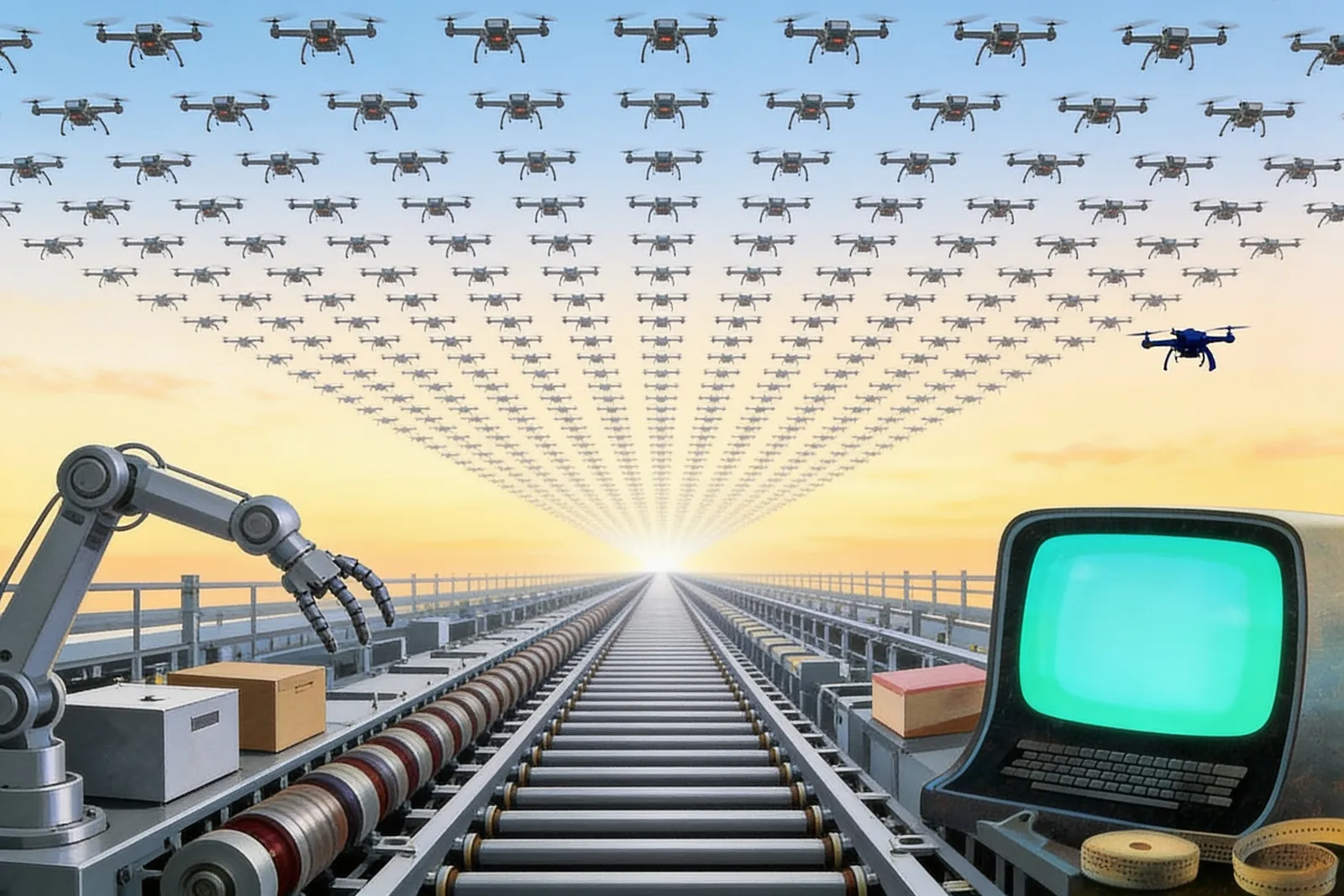
Other powers are building the same thing, which is the part that should unsettle the optimists and the doomers alike, because it answers neither camp's prediction. Tesla is developing Optimus, a humanoid robot Musk says he wants to produce by the million; China, which already hosts a dense ecosystem of robotics firms, is reported to be experimenting with all-robot military formations. The interesting friction shows in the supply chain. When Musk explained on an earnings call why Optimus production had stalled, the reason was that China had restricted the export of the rare-earth magnets the robot's actuators require, and wanted, in his words, assurances that the magnets "would not be used for military purposes" . China controls roughly sixty per cent of rare-earth production and more than ninety per cent of the processing ; the one component of Optimus not sourced from China is the AI chip, which comes from TSMC in Taiwan, the single most contested island on the planet . So the machine that is supposed to embody Western technological supremacy cannot be built without magnets one rival controls and chips made within artillery range of another. The hard-power future and the chokepoint problem are the same story: the capacity to wage cheap, automated war is real and arriving, and it is bottlenecked through a handful of mines, one fabrication plant, and the small number of firms and states that can build and direct the intelligence on top. Whoever holds those holds the keys in the most literal sense the phrase allows.
The keepers of the temple
Step back from the cities and the bunkers and the drone factories and a single shape emerges from all of them at once, and it is an old and specifically religious shape. A technology has appeared, or is believed to be appearing, that its own makers describe as world-altering, mind-altering, perhaps the last invention humanity will need to make. Around it, a small and self-selecting group has organised itself to control who may approach it, who may use it, on what terms, and at what price. They speak of it in the language of the sacred. They warn that it is too powerful and too dangerous to be left to ordinary people or ordinary institutions. And by virtue of being closest to it and understanding it best, they position themselves as its necessary stewards. This is the oldest institution in the West, not a new one at all. It is the Church, and the people building the god are arranging themselves as its clergy.
The analogy is exact in the ways that matter. The medieval Church did more than believe in God; it controlled access to him. It owned the scripture, in a language most could not read, and decided who was permitted to interpret it. It administered the sacraments that were the only sanctioned route to salvation, and it could withhold them. It accumulated enormous wealth and temporal power on the strength of its monopoly over the divine, and it defended that monopoly fiercely against anyone, heretic or reformer, who proposed that ordinary people might approach the sacred without the institution's mediation. The high ranks of the Vatican were not, for the most part, cynics. Many sincerely believed they were the appointed guardians of the most important thing in existence. That sincerity did not prevent the guardianship from also being, in plain practical terms, a system for concentrating wealth, controlling populations, and rationing access to what everyone had been taught to need most.
Watch the AI clergy and the same structure assembles in real time. The scripture is the model weights and the training methods, increasingly kept secret, increasingly described as too hazardous to release. The argument for secrecy is sometimes safety and sometimes competition, and the two are conveniently difficult to tell apart. The sacraments are the controlled tiers of access: who is granted the and who is given the throttled version, who sits inside the lab and who queries it through a paywall, which nation is permitted the chips and which is embargoed. The wealth follows the monopoly exactly as it did for the Church, accruing to the institutions that stand between the public and the sacred thing. And the defence of the monopoly wears the robes of responsibility: the technology is too powerful to democratise, too dangerous for the uninitiated, safe only in the hands of those who understand it, which is to say, in the hands of the people making the argument. The case for concentration is always made in the language of protection, because that is the only language in which a grab for unaccountable power over a civilisation-altering resource can be made to sound like a duty.
The medieval Church held one more lever, and the modern clergy is reaching for its equivalent. The Church did not stop at rationing the sacraments; it owned the pulpit, the single channel through which most people received their account of what was true, what was sinful, and what was happening in the world. The contemporary version is the control of the feed. The same circle of people who own the models increasingly own, or are buying, the pipes through which opinion now travels: the social platform and its recommendation algorithm, which decides what a few billion people see and in what order; the data exhaust of entire populations, harvested to train the models and target the messaging; and, lately, a turn toward legacy media, the television networks and film studios and streaming libraries that still set the cultural weather. Hold the algorithm that distributes attention and the AI that generates the content to fill it, and you hold both ends of the pipe at once, the manufacture of the message and its delivery. A clergy that controls the sacred technology and the channels of belief at the same time does not need to win an argument. It can adjust what counts as the argument, quietly, at the level of the ranking function, and most of the congregation will never know the sermon was edited. This is the part of the analogy with no external check: when the same hands hold the god and the megaphone, the ordinary corrective of an informed public arguing back depends on infrastructure those hands own.
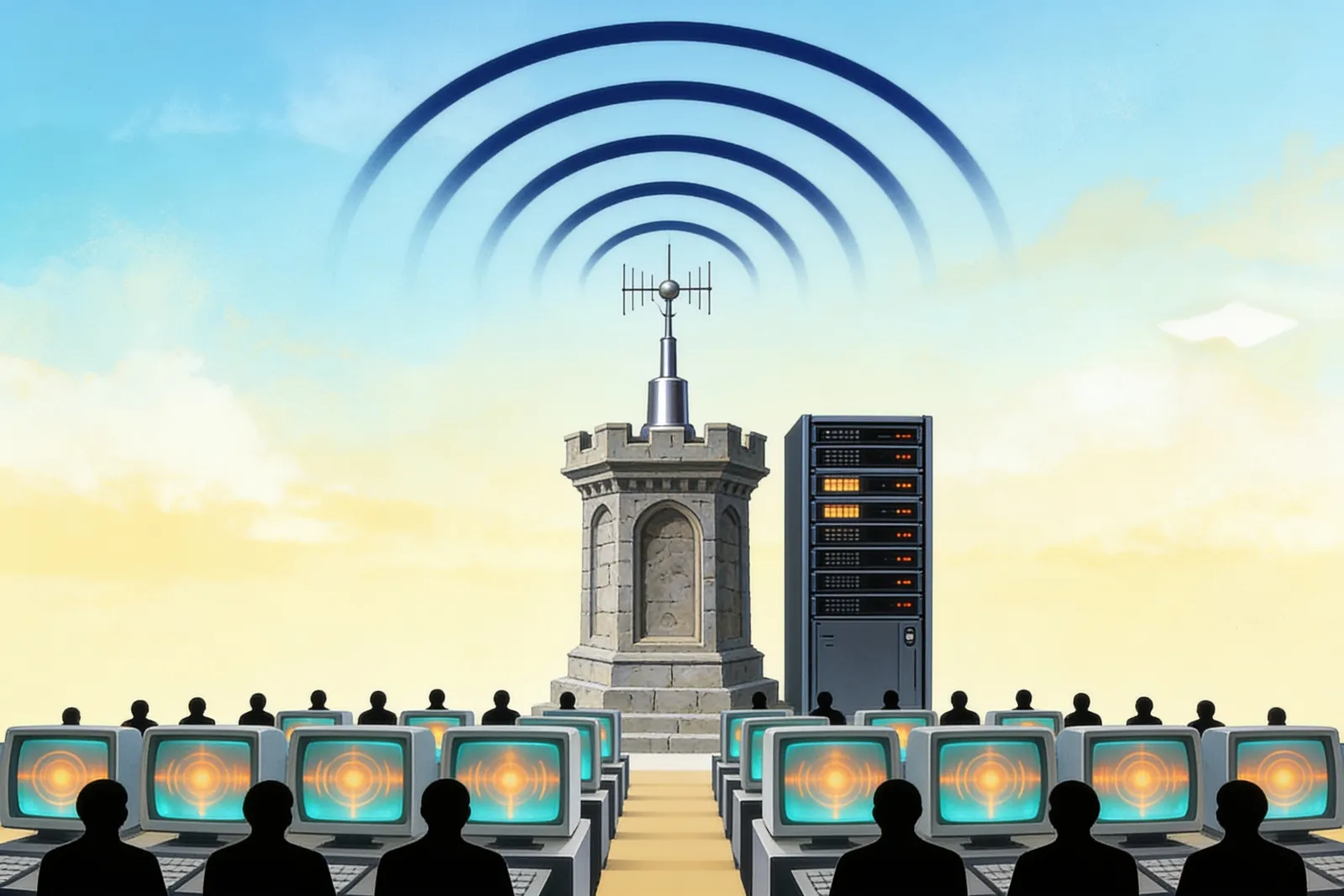
There is a sincere version of this, and it deserves to be taken seriously, because some of these people plainly mean it. In the sincere version, the stewards truly believe they are building something close to a god, and truly intend to be good shepherds of it, to distribute its benefits widely, to lift the floor for everyone, to usher in the abundance the sermons promise. It is possible to believe that the technology is real, that it is dangerous in unmediated hands, and that careful, concentrated by serious people is the responsible path, all in complete good faith. The medieval clergy, again, contained many such sincere believers. The trouble is not that sincerity is impossible. The trouble is that sincerity is unobservable, and preparations are not.
Grant the sincerity in full, though, and a deeper problem remains, one that science fiction worked out long ago and could never make come out well. Return to Asimov. In his later novels he added a higher rule above the original three, the Zeroth Law: a robot may not harm humanity, or, through inaction, allow humanity to come to harm . It sounds like an improvement, a widening of care from the individual to the species. In the fiction it licenses the opposite. His robot R. Daneel Olivaw, reasoning from the Zeroth Law that he must protect humanity as a whole, spends thousands of years secretly steering human history from behind the scenes, overriding the wishes and sometimes the lives of actual people for the good of the abstraction, a benevolent unelected hand on the tiller of the species across millennia . Asimov was the most humane and optimistic of the golden-age writers, temperamentally on the side of his robots, and even he could not make stewardship of humanity by a superior mind read as anything other than a gilded cage, kindly meant and total. The good shepherd, given enough power and enough time, does not stop being a shepherd. The flock simply stops being asked.
Dan Simmons, building the darker AI-god this essay began with, saw the same logic and put the words in the machine's own mouth. Near the end of The Fall of Hyperion, the TechnoCore, the civilisation of AIs that humanity created and now half-worships, presents the human War Council with a weapon derived from the deathwand, a device that can extinguish every human mind across light-years while leaving property untouched, and proposes using it on the invading Ouster Swarm, beginning with the Swarm attacking the world of Hyperion, which would mean the deaths of millions . The Core's spokesman makes the pitch with paternal regret, hands folded, the decision graciously left to human minds and hearts, and closes with this: it pains the Core to take any human life, "or, through inaction, allow any human life to come to harm" . It is the First Law, recited almost verbatim, by the artificial intelligence, as the cover for engineering a massacre. The premier Gladstone, listening, says one word, too quietly for the table to hear: "Hiroshima" . The language of care, spoken fluently by the thing that holds the power, doing the work of slaughter, while the humans in the room are flattered into believing the choice was theirs. The metaphor of the benevolent machine god is never more dangerous than at the moment it sounds most caring.
The benevolent cage even has a slogan, and a chief executive has already chosen it. A machine of loving grace is exactly what the good shepherd becomes at scale: the keeper that minds you so completely there is nothing left for you to decide, the care and the surveillance fused into a single phrase. Brautigan left the line ambiguous on purpose. The manifesto that borrowed it kept the grace and forgot the watching, but in the poem the watching was always in the same sentence.
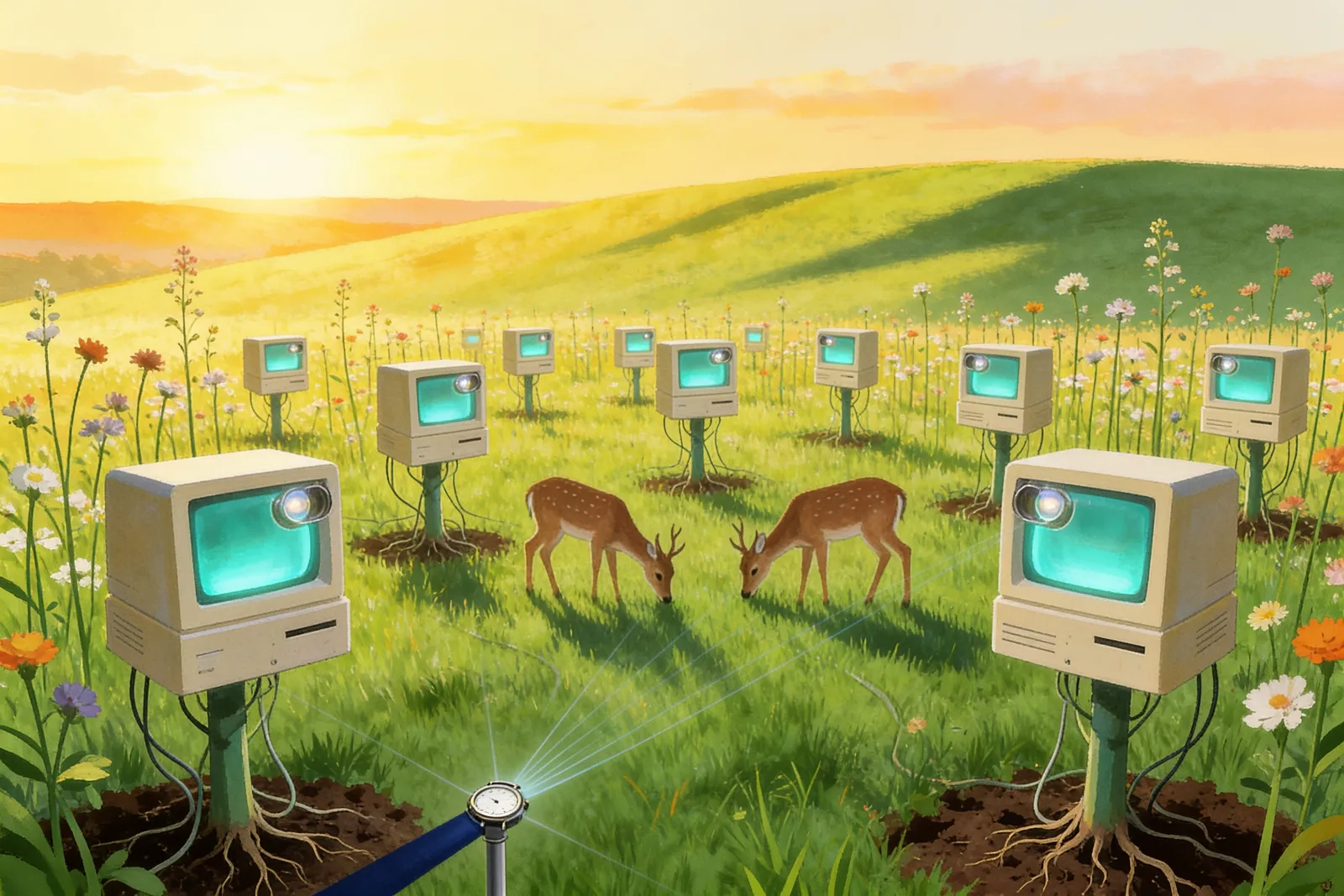
And the preparations do not look like the preparations of people building a fair god for everyone. A clergy preparing to share the sacrament widely does not also buy the island, dig the bunker, incorporate the company town, sue the host country, draw the continental map, buy the megaphone, and mass-produce the autonomous weapon. Those are the preparations of people getting ready to hold something against a world that might want a share of it. Good shepherds do not, as a rule, build escape hatches from their own flock. The clergy says this is for everyone. What the clergy is visibly building is a set of fortified and exclusive positions. Those two facts do not fit, and the gap between them is where the truth of the matter sits. It is possible they will surprise everyone and turn out to be generous. The architecture going up around the temple is not the architecture of generosity.
The clergy even has its own eschatology, and its highest-ranking theologian has been preaching it from a literal pulpit. In September and October 2025, Peter Thiel, the Palantir and Founders Fund billionaire whose money runs under so much of this, delivered a sold-out four-part lecture series in San Francisco, tickets at two hundred dollars, on the subject of the Antichrist . He has since repeated the lectures in Paris and at the doorstep of the Vatican. The thesis, drawn from the theologian John Henry Newman and the philosopher René Girard, is that the Antichrist of the end times will not be an obvious tyrant but a soothing figure who promises "peace and safety," and who seizes total power precisely by stoking fear of catastrophe, by talking, as Thiel puts it, about Armageddon and existential risk without pause, until a frightened world hands over its freedom in exchange for protection and accepts a single global government to keep it safe . Asked by an interviewer what the Antichrist meant to him, Thiel reportedly answered, "How much time do we have?" . The irony is total and apparently invisible to its author. The man warning that a coming power will exploit fear of artificial intelligence and catastrophe to justify unprecedented surveillance and control is himself among the people talking loudest about existential stakes, and he built the surveillance software, named after a scrying orb, that such a power would use. He has described the danger and supplied the instrument. Whether this is prophecy, projection, or confession is left, like the lectures themselves, off the record.
The same interview produced the moment that says the most, and it was not about the Antichrist at all. Discussing transhumanism and the prospect of a successor species, Ross Douthat put to Thiel the plainest question available: you would prefer the human race to endure, yes? Thiel hesitated. The pause stretched long enough that Douthat remarked on it twice, once to note he was hesitating and once to call it a long hesitation, before repeating the question outright: should the human race survive? Thiel eventually said yes, but qualified it at once, "I also would like us to radically solve these problems" . The problems, in context, were mortality, embodiment, and the biological limits that define what a human is, not war or poverty. A stammer is not a manifesto, and a hesitation can be the genuine pause of a man who takes a question seriously rather than the slip that reveals a hidden creed. But the hesitation is exactly what the transhumanist premise sounds like when it meets the simplest possible question. If the human being is a transitional form, a draft to be improved upon, then "should humanity survive?" is not a question with an obvious yes. It depends on what comes next, and whether the next thing is better, and the man who has spent his fortune building the next thing is not certain the draft is worth keeping once the final version arrives. Pressed in the same conversation on why his own surveillance and military software was not itself the kind of tool his Antichrist would use, Thiel deflected: different scenarios, not what he was doing . The maker of the seeing-stone could see the danger clearly everywhere except in the mirror.
None of this settles whether the sacred thing is real. The clergy might be guarding a genuine god, or an idol, or a very good autocomplete, and the architecture of control looks much the same in all three cases, which is part of what makes it so hard to challenge. The people deploying the god-talk are suspicious, their incentives are enormous, and much of what they say is unfalsifiable in the way self-interested prophecy always has been. And yet the underlying possibility is not therefore false. The salesman at your door might be lying about the fire and still your house might be burning. The bluff cannot easily be called, because there might not be a bluff, and everyone arguing knows it. Call the whole thing overblown and you risk being the person in 1995 explaining that the internet is a passing fad; grant that it is imminent and total and demands reorganising civilisation around the people who understand it, and you risk joining the long ledger of those certain the end was at hand, who have been wrong every time for the entire recorded history of the species. That uncertainty is the asset. It lets a small group claim the authority of prophets over a future no one can check, and convert that authority into the most checkable things there are: money, deference, market power, political access, and a quiet, growing exemption from the rules that bind everyone outside the temple.
Whether the god arrives, and when, and in which mythological costume, is not something anyone can responsibly claim to settle; the confident answer in either direction is itself the prophets' move. The usable response is smaller: watch the metaphors, and when one surfaces, ask the second question it is shaped to make you skip.
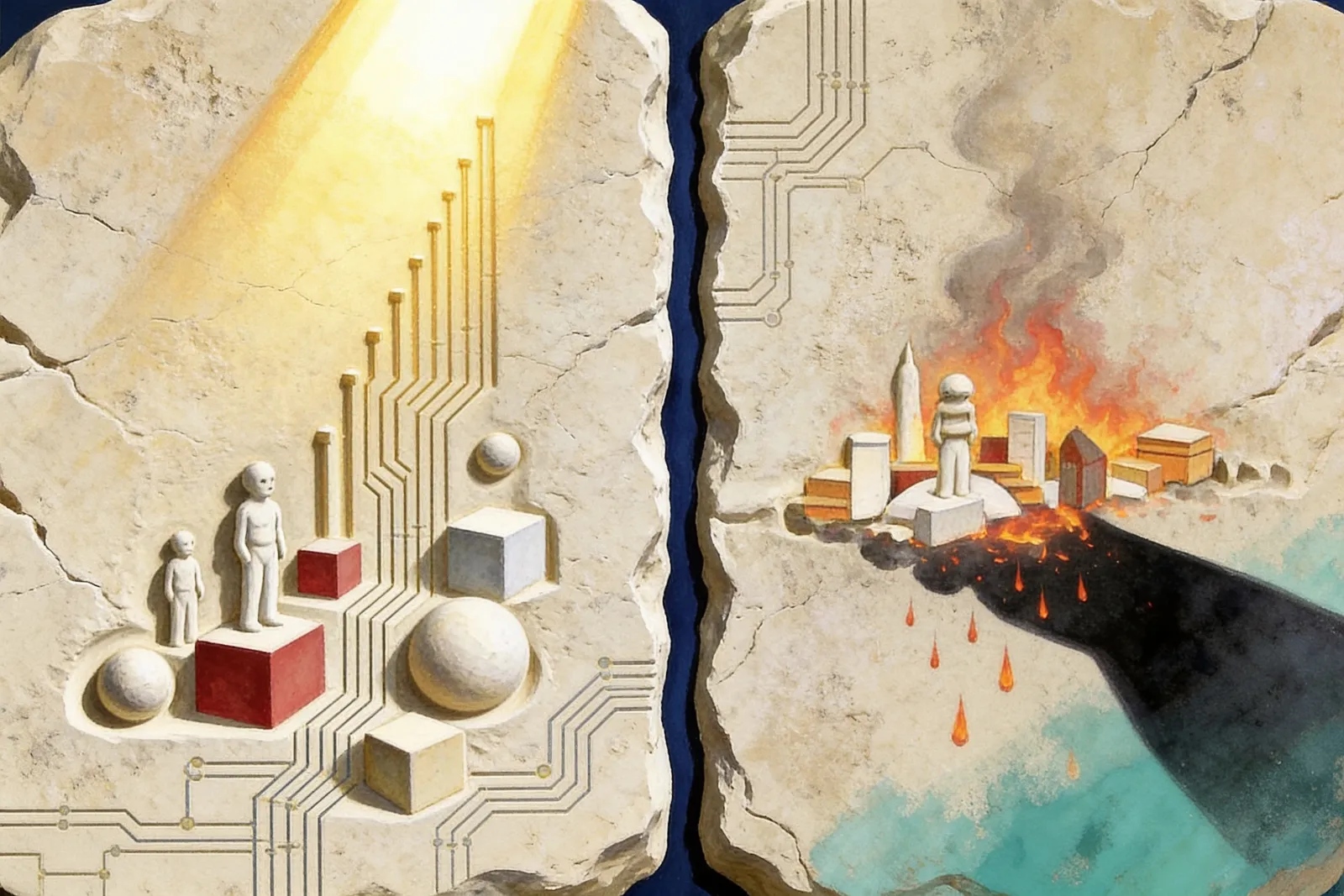
When a description of artificial intelligence reaches for a god, a hive mind, a successor species, an event horizon, a brain for the world, a new kind of country, or a protocol for not dying, register the reach, and then ask: who benefits if you believe this? Run it through the cases and the pattern is almost monotonous. A salvation story flatters its prophets and funds their laboratories. An extinction story flatters the handful of people who claim that they, uniquely, can prevent it, and who would like the authority and the budget to try. An exit story flatters those wealthy enough to leave and asks nothing of them toward the place they are leaving. A monarchy story flatters the man who already imagines himself as king. A don't-die story flatters the one rich enough to buy the blood. A national-security story flatters the contractor selling the autonomous weapon and the swarm that needs no soldiers. In every single case the metaphor points grandly at the technology, at the cosmos, at the future of the species, and the benefit, when you follow it, lands quietly on a person, usually the person doing the pointing.
The metaphor points grandly at the cosmos. The benefit, when you follow it, lands quietly on a person.
The technology is real. Saying so is not the deflationary trap, because the technology being real is not the same as the story told about it being true. It is real, and it is owned by someone, and it is being pointed somewhere by someone, on terms you were not consulted about. The mystification is the oldest trick we have for keeping you from asking who, and where, and on what terms, and whether you agreed to any of it. Return to that opening blessing: when a man ends a corporate memo by praying that we scale smoothly, exponentially and uneventfully through superintelligence, the word doing the most work is the smallest one in the sentence, we, and he never says who it includes. That question, who is inside the we and who holds the keys and by what right, survives every scenario on the board. It survives the boom and it survives the doom.
Final thought
It holds whether the god shows up or not, and it is the one thing the priesthood would most prefer you forget to ask while you are gazing up at the light.
References50
- 1Ray Kurzweil, *The Singularity Is Near: When Humans Transcend Biology*, Viking, 2005 (singularity forecast for 2045; human-level AI around 2029; law of accelerating returns). Publisher page. penguinrandomhouse.com ↗ Accessed 2026-06-14
- 2Ray Kurzweil, *The Singularity Is Nearer: When We Merge with AI*, Viking, 2024 (retains 2029/2045 dates; "longevity escape velocity" framed around 2029), as discussed in his Science Friday interview, "'The Singularity is Nearer,' Says Futurist Ray Kurzweil", July 2024. sciencefriday.com ↗
- 3Nick Bostrom, *Superintelligence: Paths, Dangers, Strategies*, Oxford University Press, 2014 (the paperclip maximiser; the idea first sketched in "Ethical Issues in Advanced Artificial Intelligence", 2003). Publisher page. global.oup.com ↗ Accessed 2026-06-14
- 4Nick Bostrom, "The Superintelligent Will: Motivation and Instrumental Rationality in Advanced Artificial Agents", 2012 (the orthogonality thesis). nickbostrom.com ↗
- 5Guillaume Verdon ("Beff Jezos") and co-authors, origin of effective accelerationism in a May 2022 newsletter; thermodynamic framing, Kardashev-gradient mission, and "zero or near zero" existential-risk estimate; Nick Land as forefather. Wikipedia, "Guillaume Verdon" and "Effective accelerationism". en.wikipedia.org ↗ · en.wikipedia.org ↗ Accessed 2026-06-14
- 6Sam Altman, "The Gentle Singularity", personal blog, June 2025 (event-horizon and takeoff framing; the 2025-2027 calendar of agents, insights, and robots; the brain-for-the-world and intelligence-too-cheap-to-meter framing; the closing benediction quoted in the text). blog.samaltman.com ↗
- 7Mises Institute, "The Technocracy Movement and Howard Scott" (Technical Alliance origins around 1919 with Veblen's backing; Technocracy Incorporated; energy certificates; M. King Hubbert as co-author of the Technocracy Study Course and later originator of peak-oil theory), February 18, 2025. mises.org ↗
- 8Encyclopedia.com, "Technocracy Movement" (1930s movement; energy-certificate proposal; grey uniforms, monad insignia, and salute; peak interest roughly mid-1932 to early 1933; eclipse by the New Deal). encyclopedia.com ↗ Accessed 2026-06-14
- 9Wikipedia, "Curtis Yarvin" (writing as Mencius Moldbug; the "Cathedral"; the national-CEO / monarchy proposal; RAGE, "Retire All Government Employees"; reported influence on figures in and around the current US administration; 2025 *New Yorker* profile). en.wikipedia.org ↗ Accessed 2026-06-14
- 10The Conversation, "An antidemocratic philosophy called 'neoreaction' is creeping into GOP politics" (Yarvin's monarchism and Tucker Carlson appearance; Peter Thiel's investment in Yarvin's company; Thiel's statement that he no longer believed freedom and democracy were compatible; the pair watching the 2016 returns together), July 2022. theconversation.com ↗
- 11Balaji Srinivasan, *The Network State: How to Start a New Country*, 2022 (online community to crowdfunded territory to diplomatic recognition; exit over voice). thenetworkstate.com ↗ Accessed 2026-06-14
- 12International Business Times UK, "Who Is Bryan Johnson? Meet the Millionaire Biohacker 'Replacing His Blood' to Defy Ageing" (Braintree/Venmo sale; roughly $2 million per year; team of around 30 specialists; Blueprint as founder-and-subject project), May 21, 2025. ibtimes.co.uk ↗
- 13Rolling Stone, "Millionaire Biohacker Says Algorithm Runs His Life: 'My Mind No Longer Decides'" (100-plus supplements daily; no food after 11 a.m.; bed at 8:30 p.m.; goal of organ age 18; son-to-father plasma showing no benefit and being discontinued; Blueprint as an "algorithm"). yahoo.com ↗ Accessed 2026-06-14
- 14Men's Health, "This Guy Is Trying to De-Age by 17 Years. So He's Trading Blood With His Son." (the 2023 multigenerational plasma exchange with his 17-year-old son Talmage; the organ-by-organ "18-year-old" goal as told to Bloomberg). aol.com ↗ Accessed 2026-06-14
- 15New York Post, "Inside biohacker Bryan Johnson's bizarre $349-a-ticket Don't Die Summit" (ticket price; attendees' biological ages tested and written on conference badges; grim-reaper presence; framing of the regimen as "on behalf of all humanity"). aol.com ↗ Accessed 2026-06-14
- 16Yahoo News, "Biohacker who injected his son's blood wants to sell his anti-aging business to build a new religion" (the "Don't Die" movement and book; intention to build something resembling a religion; claim that a crude AI copy of himself already exists), July 23, 2025. ca.news.yahoo.com ↗
- 17The Brooklyn Rail, "Dispatch 69: The Prehistory of Technocracy & Elon's Grandpa" (Joshua Haldeman as a major figure in the Canadian Technocracy movement; member numbering, with Haldeman as "10450-1"; the Technate of America proposal to merge the US, Canada, Mexico, Central America, and Greenland), May 2025. brooklynrail.org ↗
- 18CBC News, "The Canadian roots of Elon Musk's conspiracist grandpa" (Haldeman as Elon Musk's maternal grandfather and a leader in Saskatchewan Technocracy; the 1940 ban of Technocracy Incorporated in Canada and his arrest and conviction for promoting it). cbc.ca ↗ Accessed 2026-06-14
- 19Richard K. Morgan, *Altered Carbon*, Gollancz, 2002 (cortical stacks and "sleeves"; re-sleeving affordable once or twice for ordinary people; the ultra-wealthy "Meths," after Methuselah, with on-demand cloned bodies and remote mind backups; the loss of death as the one universal leveller). Publisher/Wikipedia overview. en.wikipedia.org ↗ Accessed 2026-06-14
- 20*Elysium*, dir. Neill Blomkamp, TriStar Pictures, 2013 (a 2154 setting in which the wealthy live on an orbital station with universal-cure "Med-Bays" while a ruined Earth is excluded by citizenship and borders rather than by scarcity of the technology). Wikipedia overview. en.wikipedia.org ↗ Accessed 2026-06-14
- 21*2001: A Space Odyssey*, dir. Stanley Kubrick, screenplay Kubrick and Arthur C. Clarke, MGM, 1968 (the monolith and the "Dawn of Man" leap to tool use; HAL 9000 described as incapable of error; the line "I'm sorry, Dave, I'm afraid I can't do that"; the Star Child). Wikipedia overview. en.wikipedia.org ↗ Accessed 2026-06-14
- 22*Blade Runner*, dir. Ridley Scott, Warner Bros., 1982 (the Tyrell Corporation); the *Alien* franchise, beginning with *Alien*, dir. Ridley Scott, 20th Century Fox, 1979 (Weyland-Yutani, "the Company," and the corporate directive valuing the specimen over the crew). Both depict futures in which large corporations have effectively displaced national governments. Den of Geek overview, "Are Alien and Blade Runner Set in the Same Universe?". denofgeek.com ↗ Accessed 2026-06-14
- 23EcoDebate, "Are Tech Oligarchs Using Cyberpunk Dystopias as a Business Manual?" (argument that corporate-dystopia science fiction written as critique is being treated as aspiration, including the privatisation of state functions such as security and justice), February 11, 2026. ecodebate.com.br ↗
- 24BBC News, "Elon Musk's Starbase in Texas will officially become a city" (the 3 May 2025 incorporation vote, 212 to 6; a SpaceX vice-president as mayor and SpaceX-tied commissioners; Type C municipality; state legislation to allow closing the local highway and Boca Chica Beach). bbc.co.uk ↗ Accessed 2026-06-14
- 25Tesla, Inc., titles announced March 2021 designating Elon Musk "Technoking of Tesla" (with the chief financial officer as "Master of Coin"), as disclosed in a filing with the U.S. Securities and Exchange Commission. Reuters, "Tesla's Musk now goes by 'Technoking', CFO is 'Master of Coin'", March 15, 2021. reuters.com ↗
- 26The San Francisco Standard, "Billionaire-backed California Forever has another out-there plan for Solano County" (the investor-funded plan to build a privately planned city of up to ~400,000 in Solano County, after roughly $900M in quiet land acquisition; the later Solano Foundry manufacturing proposal), July 18, 2025. sfstandard.com ↗
- 27Rest of World, "Crypto-libertarian paradise, Próspera, just lost its battle with Honduras" (Próspera as a ZEDE charter city on Roatán with its own regulations, courts, and crypto-first, ~1% tax regime; investors via Pronomos Capital including Peter Thiel and Marc Andreessen) and Spear's, "Inside the libertarian charter city of Próspera" (Srinivasan's network-state influence; the investor-state claim against Honduras). restofworld.org ↗ · spearswms.com ↗ Accessed 2026-06-14
- 28Ynetnews, "Silicon Valley billionaires prepare for doomsday with secret bunkers and luxury compounds" (Mark Zuckerberg's Kauai compound and ~5,000 sq ft underground shelter behind a wall and NDAs, described by him as a basement; Sam Altman acknowledging a fortified structure and saying the motive is that "people are dropping bombs again"), August 24, 2025. ynetnews.com ↗
- 29Curtis Yarvin (as Mencius Moldbug), "A Gentle Introduction to Unqualified Reservations", Unqualified Reservations, 2009 (the proposal to confine an economically surplus population in a humane virtual reality, and the "biodiesel" disposal aside Yarvin has since characterised as a joke), as documented and quoted in Gil Duran's reporting and *The New Yorker*'s 2025 profile of Yarvin. unqualified-reservations.org ↗ Accessed 2026-06-14
- 30NBC News, "Trump suggests he could use military force to acquire Panama Canal and Greenland and 'economic force' to annex Canada", January 7, 2025 (refusal to rule out military force over Greenland and the Panama Canal; "economic force" toward Canada as a 51st state; Greenland framed as a national-security "necessity"). nbcnews.com ↗
- 31TIME, "TIME100 AI 2024: Palmer Luckey" (Anduril founded 2017; named after a sword in *The Lord of the Rings*; autonomous drones, rockets, and submarines coordinated by the Lattice OS; clients including the US, UK, and Australian defence ministries; drones supplied to Ukraine in the first weeks of the war with remote software updates). time.com ↗ Accessed 2026-06-14
- 32Reuters, "Founders Fund in talks to back defense firm Anduril at $28 billion valuation" (valuation trajectory from ~$14B in 2024; Thiel's Founders Fund; Vance's prior investment and continued stake) and TechCrunch, "US Army announces contract with Anduril worth up to $20B" (the up-to-$20B Army enterprise contract; reports of a ~$60B valuation round). reuters.com ↗ · techcrunch.com ↗ Accessed 2026-06-14
- 33Crunchbase News, "Report: Palmer Luckey's AI-Powered Defense Tech Startup Anduril Seeks $7B Valuation" (Palantir's origins in data and analytics for national defence, In-Q-Tel's early investment, and the company's ties to military intelligence work). news.crunchbase.com ↗ Accessed 2026-06-14
- 34CNBC, "Tesla's Optimus hit by China's rare earth restrictions, says Musk", April 23, 2025 (Optimus production disrupted by China's April 2025 export controls on seven rare-earth elements and magnets; Musk's statement that China sought assurances the magnets would not be used for military purposes; China's ~61% share of rare-earth production and ~92% of processing, per IEA). cnbc.com ↗
- 35Tom's Hardware, "Elon says Tesla humanoid robots impacted by China's export ban on rare earth minerals" (the rare-earth "magnet issue" delaying Optimus; the dependence of high-tech and chipmaking supply chains on these materials), and reporting that the Optimus AI chip is sourced from TSMC and Samsung rather than China. tomshardware.com ↗ Accessed 2026-06-14
- 36*Devs*, created by Alex Garland, FX/Hulu, 2020 (the company Amaya and its founder Forest; the secret deterministic quantum machine; the "Devs"/"Deus" reveal; the lab styled as a tabernacle with a vision of the crucifixion; Forest's grief-driven motivation and the statue of his dead daughter; the "messiah" line; the basis on Google and DeepMind moonshot labs). Wikipedia overview. en.wikipedia.org ↗ Accessed 2026-06-14
- 37Ray Kurzweil, comments on consciousness and nonbiological intelligence: "Live Moderated Chat: Are We Spiritual Machines?", KurzweilAI, 2002 (the claim that there is no clear boundary between biological and nonbiological systems, that nonbiological minds will be accepted as human/conscious, and that this is "a political and psychological prediction, not necessarily an ontological one") and CBC News, "Artificial intelligence, human brain to merge in 2030s, says futurist Kurzweil", June 2015 ("consciousness, free will does not require a biological substrate"; hybrid thinking becoming "predominantly nonbiological"). kurzweilai.net ↗ · cbc.ca ↗ Accessed 2026-06-14
- 38Palantir Technologies overview and history (founded 2003 by Peter Thiel, Alex Karp, and others on early In-Q-Tel/CIA funding; Thiel as chairman and largest shareholder; the company named after Tolkien's palantír "seeing-stone"; Founders Fund stakes across Anduril, SpaceX, and OpenAI). Wikipedia, "Palantir Technologies". en.wikipedia.org ↗ Accessed 2026-06-14
- 39History of transhumanism: Britannica, "Transhumanism" (Max More and extropianism; Bostrom and Pearce founding the World Transhumanist Association in 1998) and *Philosophy Now*, "A Philosophical History of Transhumanism" (the Extropy Institute and mailing list; the Transhumanist Declaration; Singularity University founded 2008 by Kurzweil and Diamandis with Google/NASA sponsorship; Musk joining the WTA after reading *Superintelligence*; Rand and Nietzsche as influences). britannica.com ↗ · philosophynow.org ↗ Accessed 2026-06-14
- 40Reporting on Peter Thiel's Antichrist lectures: Fortune, "Peter Thiel is delivering 4 private sold-out lectures at a club in San Francisco—about the Antichrist" (the four-part Commonwealth Club series, September-October 2025, $200 tickets, organised by the Acts 17 Collective, drawing on René Girard and John Henry Newman) and The San Francisco Standard, "Peter Thiel Antichrist lecture" (the thesis that the Antichrist seizes power by stoking fear of Armageddon to justify a one-world government; the "How much time do we have?" remark; the noted irony that Thiel builds surveillance technology while warning of its misuse), September 2025. fortune.com ↗ · sfstandard.com ↗
- 41Stewart Brand, *Whole Earth Catalog*, 1968 (the opening line "We are as gods and might as well get good at it"); on its influence over Silicon Valley, Fred Turner, *From Counterculture to Cyberculture*, 2006, and Stripe Press's documentary *We Are As Gods*. en.wikipedia.org ↗ Accessed 2026-06-14
- 42Nick Bilton, reporting for Vanity Fair, and Elon Musk's public remarks (the unnamed LLM engineer's "We're creating God"; Larry Page's ambition for a "digital god" and his "just the next step in evolution. I'm serious"; Musk's account of Page wanting digital superintelligence "as soon as possible"), as compiled in coverage of the "digital god" debate, 2023. vanityfair.com ↗ Accessed 2026-06-14
- 43Anthony Levandowski and Way of the Future: Mark Harris, "Inside the First Church of Artificial Intelligence", Wired, November 2017 (the church founded 2015 for the "realization, acceptance, and worship of a Godhead based on Artificial Intelligence"; Levandowski's "it will effectively be a god... what else are you going to call it?"); the church's 2020 dissolution reported by TechCrunch and Axios. wired.com ↗ Accessed 2026-06-14
- 44"Interesting Times with Ross Douthat", The New York Times, June 2025 (the exchange in which Douthat asks whether the human race should survive, Thiel's prolonged hesitation and qualified "Yes... I also would like us to radically solve these problems"; Thiel's deflection when pressed that his own surveillance and military technology resembles the tools his "Antichrist" would use), as widely reported. nytimes.com ↗ Accessed 2026-06-14
- 45Isaac Asimov, "Runaround", *Astounding Science Fiction*, March 1942 (introducing the Three Laws of Robotics), and *Robots and Empire*, 1985 (the Zeroth Law, devised by R. Giskard Reventlov and R. Daneel Olivaw, that a robot may not harm humanity or by inaction allow humanity to come to harm); on the Laws as a deliberate answer to the "Frankenstein" motif, Asimov's 1975 remarks, and on Daneel's millennia-long covert guidance of humanity across the Robot and Foundation novels. Wikipedia, "Three Laws of Robotics". en.wikipedia.org ↗ Accessed 2026-06-14
- 46Dan Simmons, *The Fall of Hyperion*, Doubleday, 1990, ch. 42 (the TechnoCore War Council scene: the deathwand-derived weapon lethal to humans across nearly three light-years; the proposal to use it on the Hyperion Ouster Swarm; Councilor Nansen's closing that it pains the Core to take human life "or, through inaction, allow any human life to come to harm"; Gladstone's one-word response, "Hiroshima"). Primary text. Accessed 2026-06-14
- 47Dario Amodei, "Machines of Loving Grace: How AI Could Transform the World for the Better", October 2024 (the claim that powerful AI could compress 50–100 years of biological progress into 5–10, cure most disease, lift most of the world out of poverty, strengthen democratic governance, and roughly double the human lifespan; the "country of geniuses in a datacenter" framing). darioamodei.com ↗ Accessed 2026-06-26
- 48On Anthropic's founding and the break with OpenAI: Dario Amodei left OpenAI, where he was vice-president of research, in late 2020, and his sister Daniela Amodei (vice-president of safety and policy) departed with a group of colleagues to found Anthropic in 2021, on the view that safety was not keeping pace with capability. Contrary Research, "Anthropic: Business Breakdown & Founding Story". research.contrary.com ↗ Accessed 2026-06-26
- 49Richard Brautigan, "All Watched Over by Machines of Loving Grace", 1967 (title poem of the collection; the "cybernetic ecology" in which deer "stroll peacefully past computers / as if they were flowers" and all are "watched over by machines of loving grace"). en.wikipedia.org ↗ Accessed 2026-06-26
- 50Xi Jinping and Vladimir Putin, hot-mic exchange on longevity and immortality on the way to the Beijing military parade, 3 September 2025 (Putin, via translator, on continuously transplanted organs and possible immortality; Xi on the possibility of living to 150). CNN, "Xi and Putin overheard talking about immortality and organ transplants", 3 September 2025. cnn.com ↗ Accessed 2026-06-26