
Late Friday evening in Europe, a model that had been live for three days stopped existing for everyone. At 23:21 CEST (5:21pm Eastern), received a directive from the US government and, within hours, disabled Fable 5 and Mythos 5 for every customer on the planet . Not throttled. Not geofenced to a few sanctioned countries. Off.
The stated reason makes it stranger. The government had been shown a way to "" the model, and Anthropic's account of that jailbreak is that it amounted to asking Fable to read a codebase and fix the software flaws it found . That is the thing the model is built to do. The export-control letter, sent by Commerce Secretary Howard Lutnick to Dario Amodei, reportedly requires a licence for the export, re-export, or even domestic transfer of the two models, and reaches any foreign national, including foreign-born people working inside the United States and Anthropic's own staff . Because a single cloud endpoint serves domestic and global users from the same place, a restriction aimed at foreign access could only be obeyed by pulling the plug on everybody.
I am not interested here in whether the order was sound, and I have no special insight into the politics. The part that should hold a technologist's attention is mechanical and provider-agnostic: a service you depend on can be revoked by someone who is neither you nor your vendor, faster than you can convene a meeting about it. If your business cannot keep functioning through that, then you have a cloud strategy and no ground strategy. This is the first time a leading lab has taken a deployed, public model offline because the federal government told it to , and it will not be a one-off pattern we get to ignore.
In this article. What the Fable 5 shutdown demonstrates about depending on remote services, and what to do about it.
- What happened on Friday: the facts, and the one detail that matters.
- became a weapon: how a shared endpoint turns into something closer to a controlled national asset.
- We signed up for this: the decade of migration that put the off-switch in someone else's hand.
- Sovereignty stops being a slide: why the European reaction is real this time, and where it falls short.
- So what is your ground strategy: three layers worth building before you need them.
- Tested hardest, pulled anyway: the gap between how carefully the model was deployed and how casually access went away.
What happened on Friday
The two models come from Anthropic's Mythos-class line, which grew out of the Mythos Preview used inside , a restricted security-research programme whose participants reported finding and fixing large numbers of real vulnerabilities with the model's help . When Anthropic launched this week, Mythos 5 stayed restricted to vetted organisations and Fable 5 went public, the same underlying model with stronger output classifiers in high-risk areas like cybersecurity . Before release, the company says Fable was red-teamed for thousands of hours by the US government, the UK AI Security Institute, and third parties, none of whom found a universal jailbreak .
So the model the government pulled was, on the public record, the most heavily safety-tested commercial model Anthropic had ever shipped. Anthropic's position is that the demonstrated technique was narrow, surfaced only minor and previously known issues, and produced capability that is freely available from other deployed systems including 's -5.5 . The company called the action a misunderstanding and said it was working to restore access, without a timetable .
One detail captures the speed better than any statement. A reporter writing the story up that night still had Fable open at around 03:20 CEST on Saturday; by 04:05, before he could publish, his access was gone . That is roughly the interval between starting a draft and finishing it. Whatever you think of the decision, the relevant fact for the rest of us is the clock.
SaaS became a weapon
Export controls were built for physical things and the blueprints for physical things: chips, machine tools, source code on a disk. A licensing restriction on a remotely delivered capability is a different animal. It treats a live cloud endpoint as a controlled asset, and because that endpoint is shared, a rule written about who may use it becomes, in practice, a rule about whether anyone may .
The endpoint is now a lever
When the unit of control is a running service rather than a shipped artefact, the people who can pull that lever are no longer only your vendor. A regulator, a court, or a hostile government with jurisdiction over the vendor can reach through the vendor to you, and the vendor's compliance is your outage.
Strip the geopolitics out and the same shape appears in less dramatic clothes. A vendor in a payment dispute disables your tenant. A supplier acquired by a competitor deprecates the your integration runs on. A platform changes terms and your use case is suddenly off-side. We already knew these were risks; we filed them under "vendor management" and moved on, because they were slow, negotiable, and rare. Friday's lesson is that the worst version is none of those. It is fast, non-negotiable, and triggered by a party you have no contract with.
The thing you do not own is not the screen. I have argued before that interfaces have become disposable and that the asset is the data model and the governed API underneath. The Fable 5 shutdown extends that uncomfortably: you may not own the service either, in the sense that matters most, which is the ability to keep using it tomorrow.
We signed up for this
None of this is a betrayal of the deal. It is the deal, read closely for the first time.
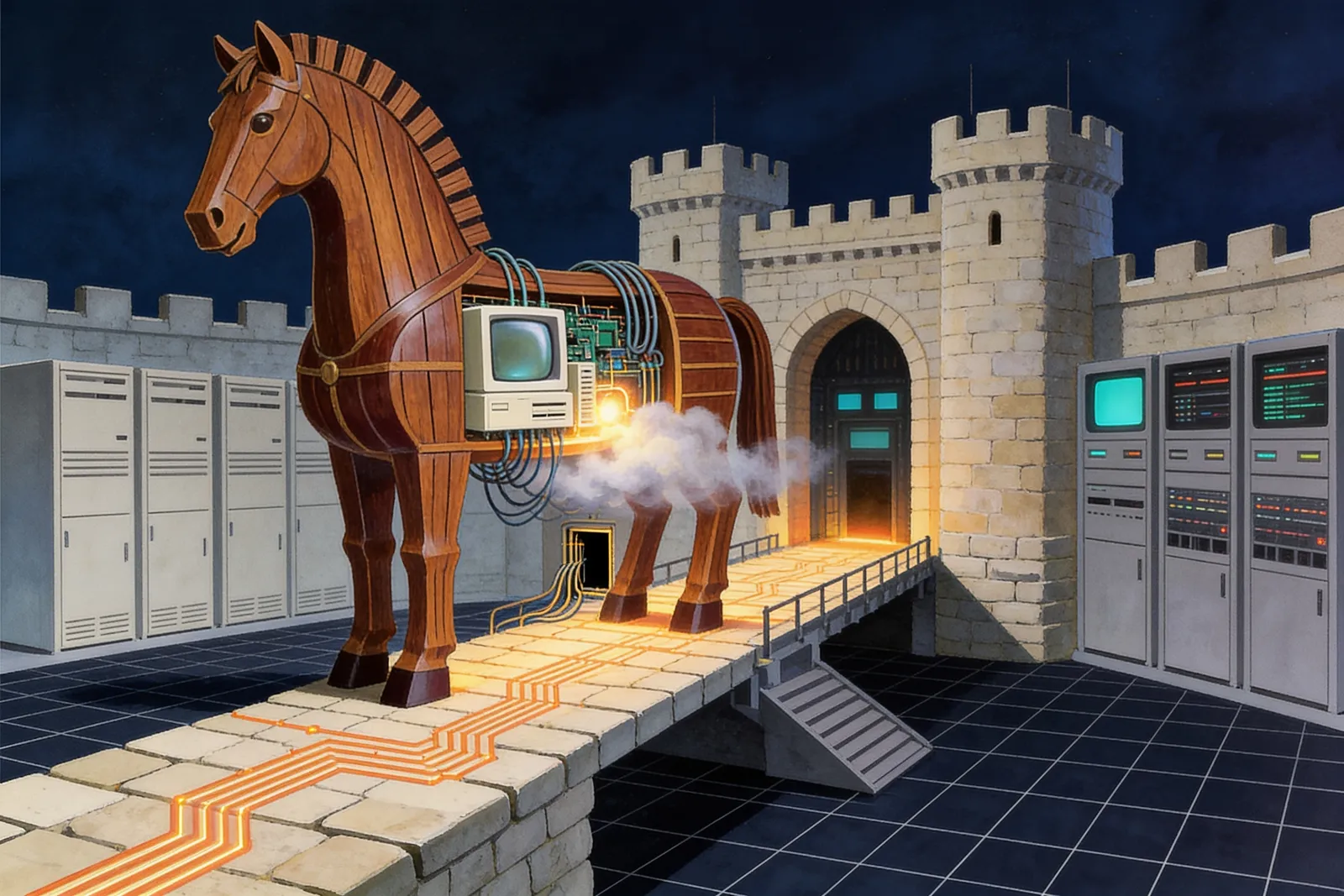
For fifteen years we moved everything off the floor and into the cloud, and the reasons were good ones. Capital expense became operating expense. Someone else owned the patching, the redundancy, the 3am pager. Vendors went cloud-first, then cloud-only, and the option quietly disappeared from the price list. By the early 2020s, telling a board you wanted to run your own data centre needed more justification than telling them you wanted to close it. The migration was rational at every step.
What we were also doing, step by rational step, was relocating the off-switch. Mission-critical data now lives in object storage we cannot physically reach. The processes that run the business run on hardware we will never see, under control planes we do not administer. And AI, the newest dependency, is the most concentrated of all: for most organisations it is served almost entirely from the cloud, by a short list of American and Chinese companies, through a metered endpoint that can be changed or withdrawn upstream. We optimised hard for cost and convenience and got both. The bill for the thing we traded away just arrived, three days after a product launch.
What we were doing, step by rational step, was relocating the off-switch.
This is not nostalgia. On-premise everything was not safer; it was differently fragile, and most of the fragility landed on small teams who could not staff it properly. The point is not "the cloud was a mistake." The point is that we let a sensible default harden into an assumption, the assumption that the services would always be there, and Friday showed the assumption has a failure we never priced.
Sovereignty stops being a slide
If you work in or near Europe, you have sat through the data-sovereignty conversation enough times to recognise the ritual: a slide, a nod, a note to revisit after the migration. This time the numbers suggest the revisiting is happening.
| Sovereign cloud spend 2026 | European growth | CIOs wanting local cloud |
|---|---|---|
| $80B | +83% YoY | 61% |
| Gartner forecast | from a $6.9B base | Western Europe |
Figures as reported June 2026; see [R6].
Gartner puts worldwide sovereign-cloud spending at roughly $80 billion in 2026, with European spending growing about 83% year over year from a 2025 base near $6.9 billion, and a clear majority of Western European CIOs saying they want to lean harder on local providers . The accelerants are real and compounding: cumulative fines reached around €7.1 billion by January 2026, and data-protection authorities in several member states have ruled against specific US tools over transatlantic transfers, which turns routine US-cloud use into a live compliance exposure rather than a theoretical one . The continent is building as well as buying: a €180 million sovereign-cloud procurement tender, national investments like Schwarz Gruppe's into STACKIT, and a roster of European AI and cloud providers, , Aleph Alpha, Scaleway, OVHcloud, positioned as alternatives outside US jurisdiction .
Now the cold water. The hyperscalers still hold roughly 70% of the European cloud-infrastructure market against about 15% for European providers, and their "sovereign" offerings, European Sovereign Cloud, the Microsoft EU Data Boundary, Google's sovereign portfolio, are run by US companies that remain subject to US law . A German data centre with European-managed keys is a strong compliance posture. It is not immunity from a directive issued to the parent company. The fully independent options, French and German sovereign clouds, partnerships like S3NS and Bleu, federated efforts like Gaia-X, trade breadth of managed services for that independence . There is no free version of this.
"sovereign" is a spectrum, not a switch
A sovereign-flavoured region from a US hyperscaler reduces some risks and leaves the jurisdictional one largely intact. If your threat model includes a directive reaching the vendor's home government, only a provider outside that jurisdiction changes the answer, and you pay for it in service breadth and integration work.
Where I sit, in Norway, the framing matters more than the EU one, but the calculus is the same: which workloads must stay close to home, which can live on a hyperscaler's sovereign tier, and which were never sensitive enough to bother. That triage is the work. It is unglamorous and it is overdue.
So what is your ground strategy
A ground strategy is the deliberately boring counterpart to your cloud strategy. It is the answer to one question asked of each critical dependency: if this is switched off upstream with an hour's notice, can we keep operating, and for how long? You will not like all the answers. That is the point of asking before the hour arrives.
It resolves into three layers, in rough order of how quickly you can act on them.
The fallback layer (shaded) is the ground strategy. Author's illustration.
Keep a copy on the ground
The first layer is the oldest discipline in the trade, and the cloud quietly let many of us forget it: hold your own copy of the data that the business cannot run without, somewhere you can reach without your vendor's cooperation, in a format you can read without their software. Object storage in a region you control, an export pipeline that runs on a schedule rather than on hope, open table and file formats so a copy is not a hostage to one engine. The test is not "do we have backups." Most shops have backups they have never restored. The test is whether you can stand the data up somewhere else and use it.
That second clause is the harder one, and it is the second layer: a way to process the data, beyond simply storing it. You do not need a full warm replica of your platform; for most organisations that is unaffordable theatre. You need enough to keep the few processes that cannot stop, the ones where a day of downtime is a regulatory or cash-flow event, limping along on improvised infrastructure while you sort the primary out. A documented path to a minimal stand-up, even a degraded one, is worth more than a beautiful disaster-recovery binder nobody has exercised. If you have never once cut over, you do not have a ground strategy; you have a document about one.
Don't rent your only brain
AI is now a dependency, so it belongs in the same exercise, and it is the layer where Friday lands hardest. Two moves matter.
First, own the part that is yours. The model is a rented, swappable input; your proprietary context, your data platform, your retrieval layer, the accumulated business meaning that makes a generic model useful on your problem, is the durable asset, and it is the part no directive can switch off because it lives with you. Invest there with the seriousness you would give any system you intend to depend on for a decade. A good model on top of a weak context layer is a demo. A modest model on top of a strong one does real work.
Second, do not wire your workflow to a single provider's front door. Provider-agnostic harnesses exist precisely so the model becomes interchangeable. , the most-starred open-source coding , is built to be uncoupled from any one vendor: it runs against Claude, OpenAI, , or a local model through Ollama, across more than 75 providers, under an MIT licence you can read . If one provider raises prices, changes terms, or vanishes from your jurisdiction overnight, you re-point the and keep going. That portability stopped being a convenience feature on Friday and became a continuity one.
This is where matter beyond cost. The capability gap between the best open-weight coding models and last year's frontier has compressed to single digits on the people cite, which means a model you can run on hardware you control is now good enough for a large share of real work, not a toy you settle for. The frontier still wins the hardest problems. It does not win most of them, and "most of them" is the part you cannot afford to have switched off.
Source closer to home
The third layer is procurement, and it is the slowest but the most structural. Where a workload is sensitive enough, prefer AI services hosted in your own region or country, from a provider whose home jurisdiction is yours. This is exactly the bet the European sovereign-AI vendors are making, and the Fable 5 shutdown is the strongest argument any of them have been handed . A model served from within the EEA, by a company incorporated there, is not reachable by a directive aimed at a foreign capital in quite the same way. It may be a weaker model. For the processes that cannot stop, weaker-and-reachable beats stronger-and-revocable.
You will not put everything behind a regional provider, and you should not try. The right shape is a portfolio: frontier American or Chinese models for the work that benefits from the edge and can tolerate interruption, a regional or open-weight fallback wired through the same harness for the work that cannot. Same principle as the data layer, applied to .
Tested hardest, pulled anyway
The model that got pulled was the one its maker had tested hardest, with the government's own people in the room for some of that testing . The triggering capability, by Anthropic's account, was asking the model to find and fix bugs in code , which is both the dullest and the most useful thing these systems do, and a capability that defenders, the people keeping systems safe, use every single day . If the standard applied here were applied across the industry, Anthropic argues, it would halt new model releases from everyone , and on the narrow facts available it is hard to see why that is wrong. A reporter watched his access disappear mid-article . Somewhere, a developer who started a refactor that afternoon came back to a tool that no longer answered. The gap I keep returning to is between how careful the deployment was and how casually the access went away. Carefulness on the vendor's side bought the customer nothing on the day it mattered, because the lever was never in the vendor's hand.
That is the whole argument for a ground strategy in one sentence. You cannot make your dependencies more careful. You can only make yourself less dependent.
The disconnect you should plan for
The cloud was the right bet and remains the right default. Nothing about Friday changes the economics that drove the migration, and a panicked repatriation of everything to on-premise would be a more expensive mistake than the one it is trying to fix. The correction is narrower and cheaper than that. Identify the handful of dependencies the business cannot survive losing for a day. For each, hold a usable copy of the data you control, a rehearsed way to process it in a pinch, and an AI layer whose model you can swap and whose context you own. For the most sensitive of them, source from your own jurisdiction even at a capability cost.
That is not a retreat from the cloud. It is the part of the plan we skipped because the services were always there, right up until one of them wasn't, at 23:21 CEST on a Friday night in Europe, with no notice and no appeal.
Final thought
Ask the question of your own estate before someone else asks it for you: what is your ground strategy?
What Is Your Ground Strategy? · June 2026 · A strategy piece on continuity risk in remotely hosted services and AI, written the day after the Claude Fable 5 / Mythos 5 shutdown. Sovereign-cloud and market figures are third-party estimates as reported; event details are drawn from Anthropic's own statement and contemporaneous reporting.
References9
- 1Anthropic, "Statement on the US government directive to suspend access to Fable 5 and Mythos 5", June 12, 2026. anthropic.com ↗
- 2The New Stack, "US Gov Orders Anthropic to Pull Fable 5 and Mythos 5, Three Days After Launch", June 12, 2026. thenewstack.io ↗
- 3NBC News, "Anthropic suspends new AI models after government directive", June 12, 2026. nbcnews.com ↗
- 49to5Mac, "Anthropic pulls Claude Mythos 5 and Claude Fable 5 following US government directive" (reporting Axios on the Lutnick letter), June 12, 2026. 9to5mac.com ↗
- 5Anthropic, "Claude Fable 5 and Claude Mythos 5" (launch post). anthropic.com ↗ Accessed 2026-06-13
- 6Dataconomy, "European Cloud Sovereignty In 2026: Where Workloads Go", June 8, 2026. dataconomy.com ↗
- 7Vstorm, "Top 5 sovereign AI platforms in Europe for 2026", April 29, 2026. vstorm.co ↗
- 8Broadcom, "Three Predictions for Sovereign Cloud in 2026", January 29, 2026. news.broadcom.com ↗
- 9OpenCode, project homepage and documentation. opencode.ai ↗ Accessed 2026-06-13